Content
LinkedIn has been having a field day lately. SEO is dead, GAIO is the new holy grail, adapt or die. The panic is real and honestly, some of it is warranted. However, about 90% of it is just noise.
Yes, the way people find information is changing. But are we at the point where SEOs should be updating their job titles? Not quite. Here's what's actually happening and what B2B SaaS marketers need to prioritize right now.
TL;DR:
AEO for B2B SaaS
- Google still dominates global search, but AI tools have become the first stop for a growing share of B2B buyers.
- 94% of B2B buyers use AI tools in their purchase research, and 1 in 3 bought from a vendor they'd never heard of because an AI recommended them.
- AEO and SEO share the same technical foundation but require a different optimization mindset.
- The bigger risk: measuring the wrong KPIs. Traffic can fall while revenue rises and most teams won't see it coming.
- Audit your AI visibility, fix your technical foundations, and invest in brand. In that order.
Google isn't going anywhere (but it's changing fast)
Let's start with the stat that tends to get lost in the doomsday discourse. Google still holds around 90% of the global search market (statcounter). People still type queries into that white box billions of times a day, and Google still rewards the same core SEO behaviors, clean content, strong authority, clear structure.
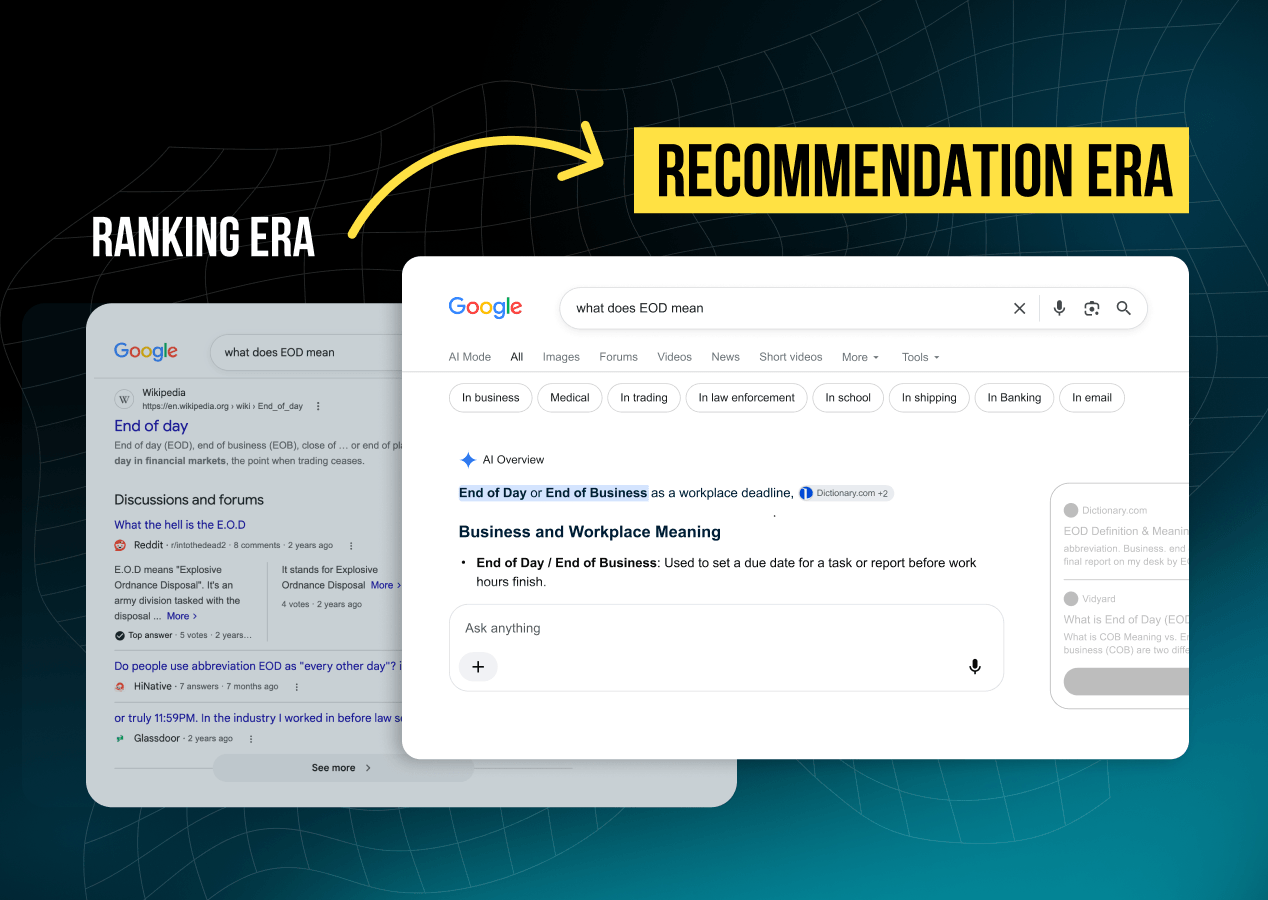
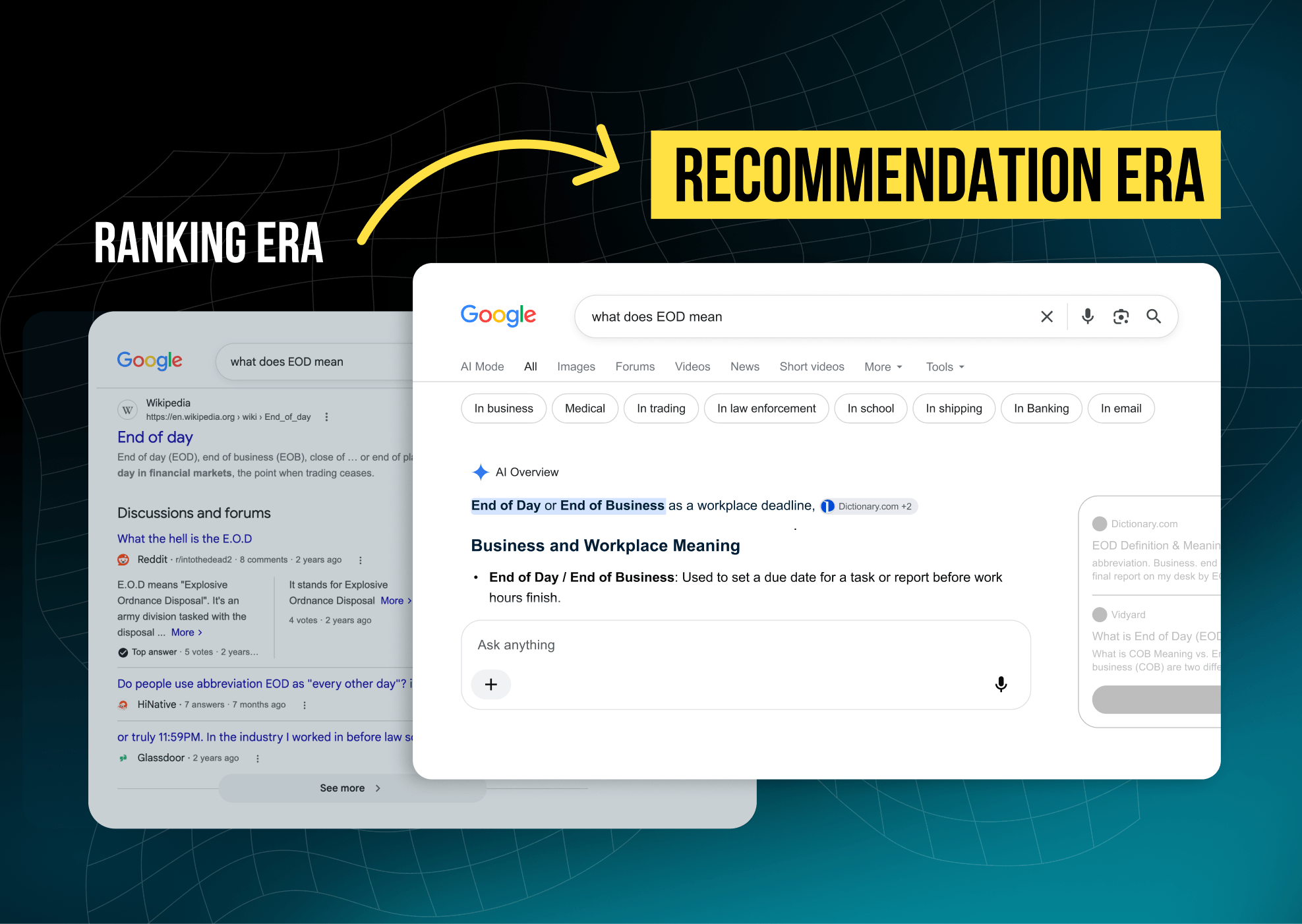
What changed is what happens after they hit enter. With AI Overviews appearing on an estimated 45% of searches and Google's AI Mode expanding, you can rank on page one and still watch your organic traffic fall, because the answer now sits synthesized above the fold, with no click required (techcrunch).
The data backs this up. Despite a 49% year-over-year increase in search impressions, average click-through rates dropped 30% in May 2025, according to Seer Interactive research across 42 organizations. Zero-click searches now account for an estimated 60% of all Google queries (semrush).
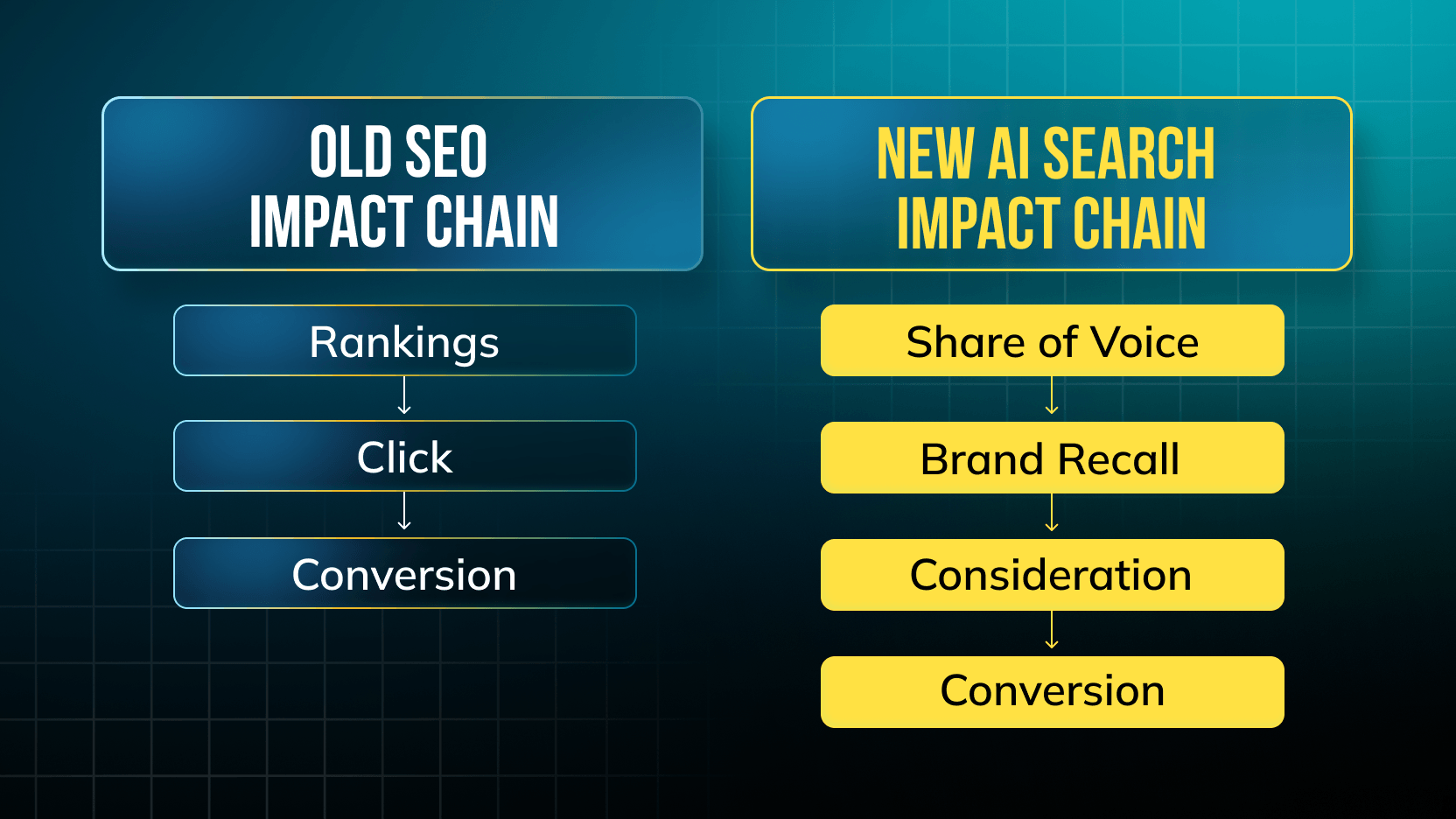
BUT this is an attribution crisis, not just a traffic crisis. We regularly see clients where clicks are down 51% year-over-year while leads are up 261%. The channel is working. The KPIs are broken. Marketing teams measuring success by traffic and CTR alone will look like they're underperforming, even when revenue is growing. The first thing to fix isn't your content. It's what you're measuring.
.png)
The way B2B buyers find information has changed drastically
What matters more than Google's evolution is a deeper shift: B2B buyers now research software differently, with AI tools driving that change.
According to research conducted by G2, 51% of B2B software buyers now begin their research with an AI chatbot rather than a search engine, up from 29% just 11 months earlier. A broader analysis found that 94% of B2B buyers use AI tools in their purchase research overall. And 1 in 3 bought from a vendor they had never previously heard of, because an AI recommended them (6sense).
Think about what that means for your pipeline. A meaningful portion of deals are going to whoever the AI thinks is the best answer. If you're not in those AI-generated shortlists, you're not in the consideration set. Full stop.
I've seen this firsthand. When evaluating a new data tool for YOYABA, our developer didn't open Google once. He described the problem to ChatGPT using voice input, ran a deep research flow, fed the output into Claude to cross-reference API capabilities against our requirements, and bought with high confidence. Without visiting a single vendor's website. That's not a future scenario. That's how B2B software is already being bought.
What is answer engine optimization even?
Answer engine optimization (AEO) is the practice of optimizing your content and digital presence to be cited, recommended, and accurately represented by AI-powered search tools like ChatGPT, Perplexity, and Google AI Overviews.
Unlike traditional SEO, which focuses on ranking pages for specific keyword queries, AEO focuses on increasing the likelihood that your content is retrieved and surfaced by the systems feeding those AI tools. Rather than chasing position one, the goal is making sure that when a retrieval system goes looking for the best match to a query your buyers are asking, your content is what it finds.
The question shifts from "how do I rank?" to "does my content contain a clear, extractable answer that maps tightly to what my buyers are searching for?" That's a meaningfully different question, and it requires a meaningfully different answer.
AEO vs SEO: Battle or stack?
AEO and SEO are not at war. They share the same technical and content foundations: clean site architecture, strong topical authority, well-structured content, credible backlinks. Good SEO is a prerequisite for AEO, not its enemy.
What is different is the optimization logic on top of those foundations.
- Traditional SEO asks: can a crawler index this and rank it for a specific query?
- AEO asks: can a retrieval system extract a clean, precise match to a buyer's question and return it to the model?
The clearest evidence of divergence: according to Ahrefs research from 2025, 80% of URLs cited by LLMs don't rank in Google for the original query.
But it's worth being precise about why, because the popular explanation "LLMs reward authority" is not 100% true.
Why LLMs don't actually reward authority
LLMs don't evaluate sources and decide what's best. They trigger isolated retrieval systems (essentially search-and-fetch pipelines) that return raw content to the model, which then summarizes whatever it received. The selection happens upstream, not in the model itself. What ends up in the response is largely determined by which content was indexed, chunked appropriately, and returned a close enough vector match to the query embedding. There's genuine randomness involved: a relatively unknown website with a single well-structured 150-word paragraph that aligns tightly with a specific query can win that slot over a domain with years of SEO authority behind it.
Structural quality still matters, just not how you think
Structural quality matters, but for different reasons than most AEO advice suggests. Clean HTML and minimal JavaScript don't help LLMs "read" your content better. They help the crawlers and indexing systems that feed those retrieval pipelines process and store your content accurately. The LLM is downstream of all of that.
So the practical optimization question shifts from "how do I build authority?" to "does my content contain a clear, extractable answer that maps tightly to the queries my buyers are asking?" Topical coverage, structural clarity, and answer-first formatting increase the surface area of content that can return a high vector match, not because an LLM is intelligently evaluating your expertise, but because the retrieval math works in your favor.
We're in the midst of transitioning from the ranking era to the recommendation era. While your SEO foundations are still essential, they no longer suffice on their own.
AEO action plan for B2B SaaS marketing teams: What you need to do now
Adapting to AI search comes down to four moves: measure how your brand actually shows up in LLM answers, optimize content and technical structure for retrieval instead of rankings, invest in the off-page and brand signals that feed both grounded and ungrounded AI responses, and diversify demand generation beyond Google organic. None of this replaces your SEO fundamentals, it just means layering a new set of priorities on top of them.
1. Get a clear picture of how you perform in AI search
Most B2B SaaS marketing teams have no view of how they show up in LLM-generated answers or how their competitors do. That's the first problem to fix.
Start manually:
- Open ChatGPT, Perplexity, and Claude.
- Search for the queries your buyers actually use: "best [product category] for B2B SaaS," "alternatives to [your main competitor]."
- Note whether your brand appears, how it's described, and who else is in the conversation.
- Then do the same for your top three competitors.
For systematic tracking, tools like Peec.ai and Profound let you monitor citation share and prompt coverage at scale.
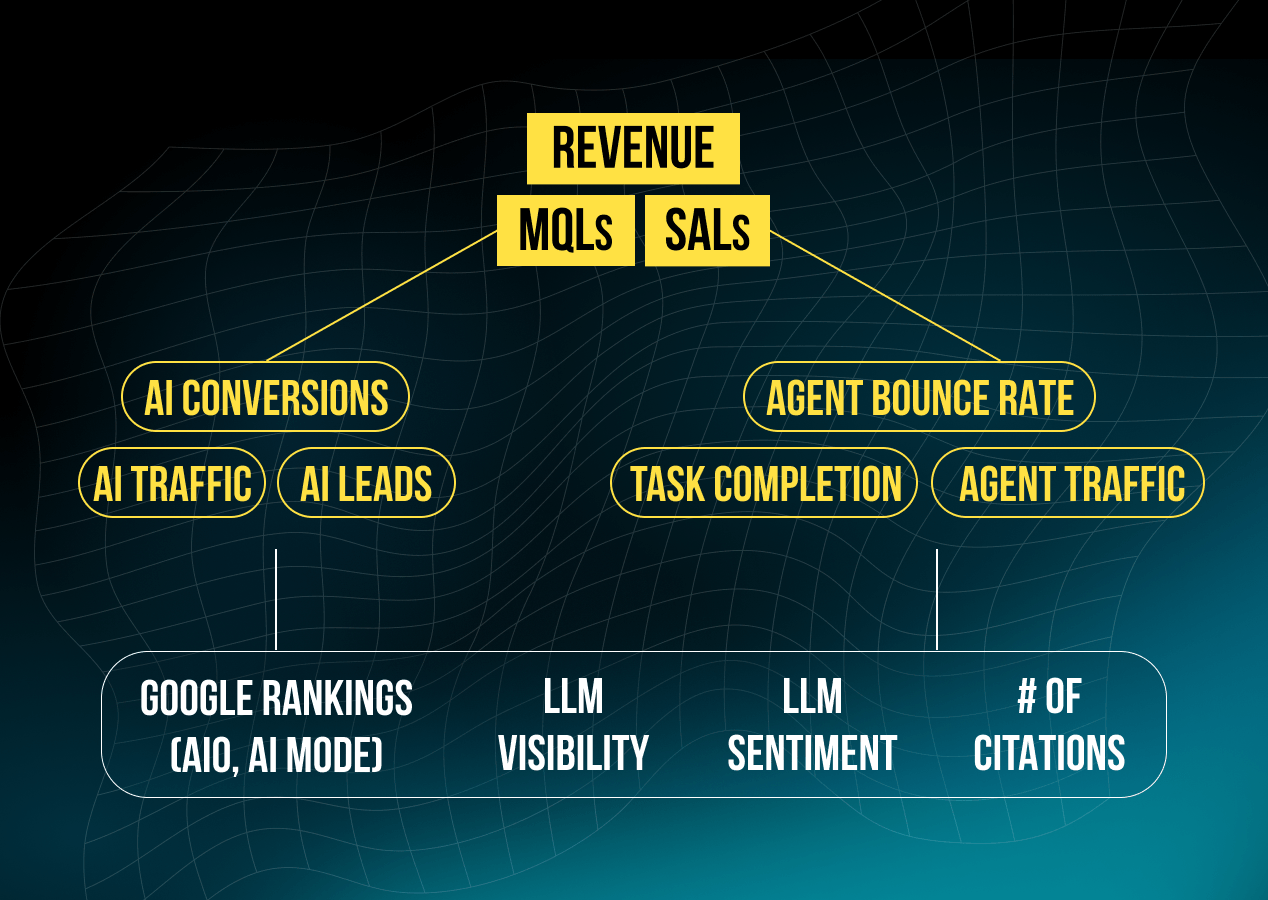
The metrics that matter here are different from traditional SEO:
- Prompt coverage rate
- Citation share / share of recommendation (SRA)
- AI referral conversion rate
According to Semrush, AI-referred visitors convert at 4.4x the rate of organic search visitors, even small volumes of AI traffic can have an outsized revenue impact (semrush).
One critical note: also set up self-reported attribution in your forms. In our experience, tool-based attribution typically shows 4% of leads coming from AI. Self-reported attribution shows 10%. The gap is significant and without both signals, you're systematically undervaluing the channel.
2. Optimize across three levers
The three highest-impact areas for AEO visibility, in priority order:
Machine readability
Can crawlers and indexing systems access and process your content? Add Organization, Service, and FAQ schema to key pages, not because it directly influences LLM responses, but because it helps upstream systems index you accurately. Structure content answer-first: question in the heading, direct 1–2 sentence answer immediately after, then the full explanation. This increases the likelihood a retrieval system returns a clean, quotable chunk as a vector match. And if you're on Cloudflare, enable Markdown for Agents. One toggle, immediate improvement in how AI crawlers process your pages.
High-intent content
Competitor comparisons, alternative pages, and category-level answers consistently perform well in LLM citations. These are the query types buyers actually use during vendor evaluation, and they map directly to the retrieval patterns that surface content in AI answers.
Web coverage
Where does your brand show up across the web? Reviews, PR, comparison articles, community mentions, these are the indexed sources retrieval pipelines pull from. Audit which domains are most frequently cited when your category is queried in LLMs. Then prioritize getting your brand accurately represented on those specific sources.
3. Invest in brand and off-page (more than ever)
This is the piece most AEO advice skips, because it's slower and harder than adding schema.
- For grounded AI responses (Google AI Overviews, ChatGPT with web search), the retrieval pipeline determines what gets cited. A strong off-page presence increases the number of indexed sources mentioning your brand accurately, giving retrieval systems more chances to return your content as a match.
- For ungrounded responses (answers drawn from training data) brand presence across credible third-party publications, analyst coverage, and community platforms is your strongest lever. LLMs are trained on the web. If you don't appear consistently, you won't be represented accurately.
In practice, both response types happen simultaneously. The strategic implication is the same either way: invest in digital PR, thought leadership, and third-party visibility. The mechanism differs; the priority doesn't.
4. Test a new channel and think more holistically
Over-reliance on Google organic has become a strategic risk. If the majority of your demand gen budget depends on traffic that is increasingly staying on the SERP, you have a concentration problem.
YouTube is the obvious first test for B2B SaaS: second-largest search engine, AI Overviews haven't disrupted it, and video content is increasingly surfaced in LLM answers. LinkedIn, podcasts, and community-led distribution are all worth a serious look.
The goal is to build a demand generation system resilient enough that no single algorithm change can cut your pipeline in half, without abandoning SEO along the way.
Lorem ipsum dolor sit amet
Lorem ipsum dolor sit amet, consectetur adipiscing elit. Suspendisse varius enim in eros elementum tristique.
Du willst deine KI-Sichtbarkeit ausbauen?
AEO is reshaping how B2B buyers discover software. To make sure you get cited you need to understand how to optimize for answer engines. And our Organic Growth & SEO Team is happy to help!
THe Bottom Line
AEO isn't replacing SEO. It's raising the bar for what good organic growth actually means.
The B2B SaaS teams that will consistently show up in AI-generated answers aren't the ones that added FAQ schema to their existing pages and called it done. They're the ones building genuine topical authority, structuring content for machine extraction, establishing real brand presence across the web, and starting to measure the metrics that reflect how AI systems actually evaluate and cite sources.
The LinkedIn doomsayers have one thing right, the playbook is changing. But the core principle hasn't changed at all: be the most credible, most useful, most clearly structured source on the topics your buyers care about. It's just more important now than it's ever been.
Your questions answered
What is answer engine optimization (AEO)?
Answer engine optimization is the practice of optimizing your content and digital presence to appear in AI-generated answers from tools like ChatGPT, Perplexity, and Google AI Overviews. The goal is to become the source an LLM cites when a buyer asks about your product category, problem space, or competitive landscape.
What's the difference between AEO and SEO?
SEO focuses on ranking pages in search engine results. AEO focuses on ensuring your content is retrieved and surfaced by the systems feeding AI-powered answer engines, so that when a retrieval pipeline goes looking for the best match to a buyer's query, your content is what it finds. They share the same technical foundations (clean site architecture, strong topical coverage, credible backlinks) but require different optimization priorities. Good SEO is a prerequisite for AEO, not a substitute for it.
What's the difference between AEO and GEO?
Generative engine optimization (GEO) is often used interchangeably with AEO (answer engine optimization). If there's a distinction, GEO tends to refer more specifically to optimizing for generative AI tools like ChatGPT and Perplexity, while AEO can also include Google's AI Overviews. In practice, the strategies are largely the same.
How do I know if my company is showing up in AI search?
Start manually: search for your key buyer queries in ChatGPT, Perplexity, and Claude. Note whether your brand appears, how it's described, and who else is mentioned. For systematic tracking, tools like Peec.ai and Profound let you monitor citation share and prompt coverage across LLMs at scale.
Does AEO replace SEO?
No. AEO builds on the foundations that good SEO creates. Strong topical authority, clean site architecture, credible backlinks, and well-structured content all contribute to both Google rankings and the likelihood of your content being retrieved by the systems feeding LLM responses. The difference is in the optimization logic on top and in the metrics you track to measure success.