Content
Your AI visibility dashboard says 32%. Leadership is happy. Yet AI-referred traffic is flat, and nobody in Sales has heard a prospect mention ChatGPT.
Usually, nobody is lying. But in most setups we audit, the number is bloated. It mixes questions about your own brand with questions buyers actually ask. It combines AI engines your buyers use with ones they don’t. And it reports on brand totals when the real decisions happen at product level.
This article answers four questions every marketing leader should be able to answer about their AI visibility reporting:
- Which metrics are actionable, and which are vanity metrics?
- How is my team measuring this today?
- Is the data I’m being shown inflated?
- What should change to make it actionable?
We use Peec AI as the working example, along with real, anonymised data from two B2B tech clients.
What is AI visibility?
AI visibility describes how often, where and how your brand appears in answers generated by AI systems such as ChatGPT, Google AI Overviews and AI Mode, Gemini or Perplexity. It is usually measured by running a defined set of prompts against these systems at regular intervals and analysing the answers for brand mentions, position, sentiment and cited sources. It is one part of Organic Growth, alongside SEO, content and the organic reach of your experts.
TL;DR:
Quick Summary on this article
- AI visibility is a sample, not a ranking. The same prompt produces different answers across runs, models and modes. Every number you see is an estimate, shaped by how the sample was taken.
- Your prompt set can manufacture your result. In one client setup, 11 branded prompts out of 100 produced most of all brand visibility, with blended visibility at 11.7% against 0.85% for unbranded prompts.
- Report unbranded visibility as the headline KPI. Track branded and comparison prompts separately, for accuracy, sentiment and positioning, not for visibility.
- Do not blend models blindly. The same unbranded prompts gave one category leader 45% visibility in ChatGPT but only 18% in Perplexity.
- Measure where decisions happen. Brand-level averages hide that you can lead in one use case and be far behind in another.
- Connect visibility to pipeline. Otherwise you have a score that only validates itself.
How AI visibility tracking actually works
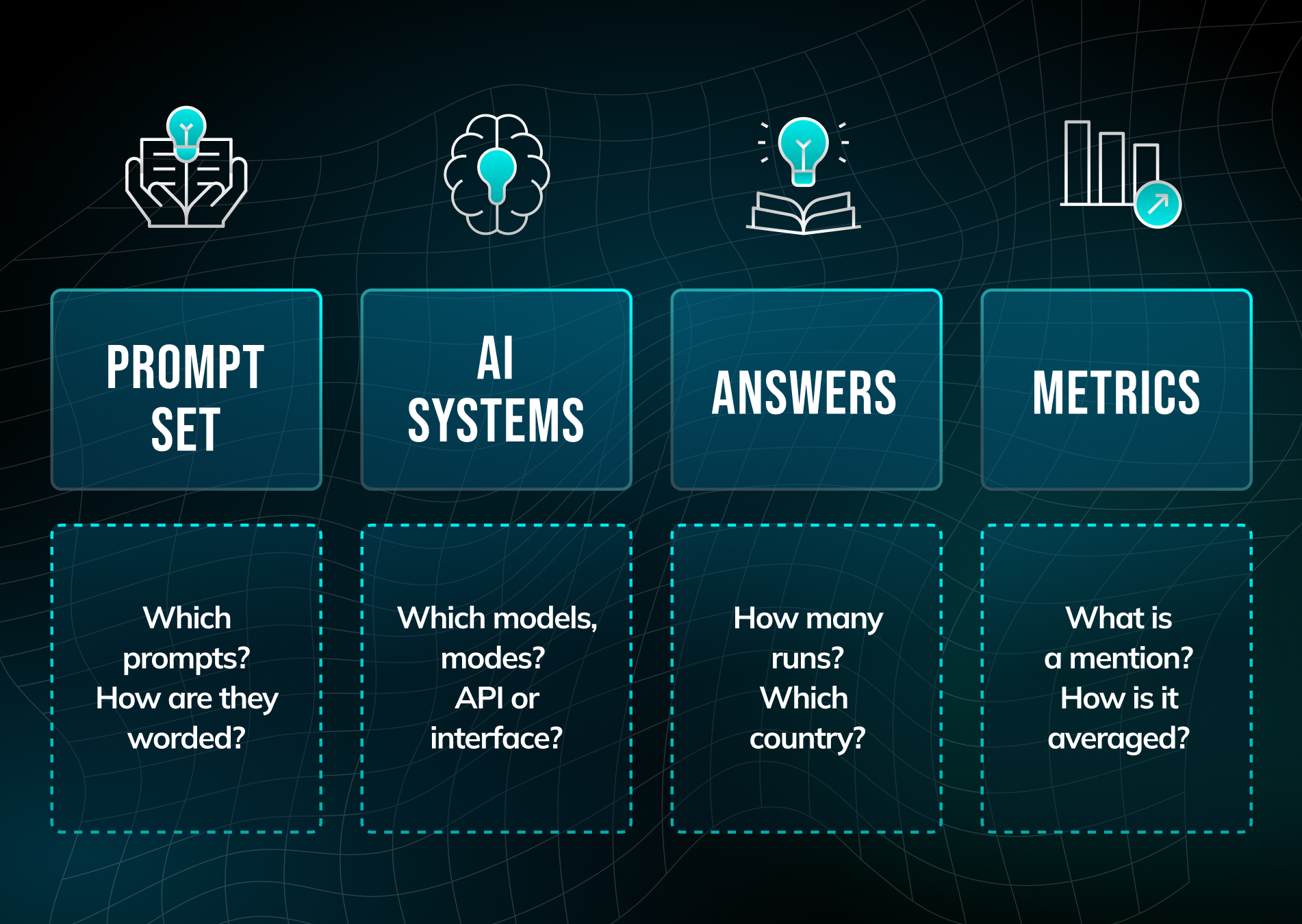
Before you trust the numbers, you need to know how those numbers were produced. Every AI visibility score rests on a few setup decisions your team made, often without realising it.
Most prompt-based AI visibility trackers follow roughly the same measurement pipeline:
- Runs a defined set of prompts against selected AI systems at a set interval
- Collects the full answers, including cited sources where the platform exposes them
- Parses each answer for brand mentions, position in lists, sentiment and sources
- Aggregates the results into metrics across prompts, models, countries and time
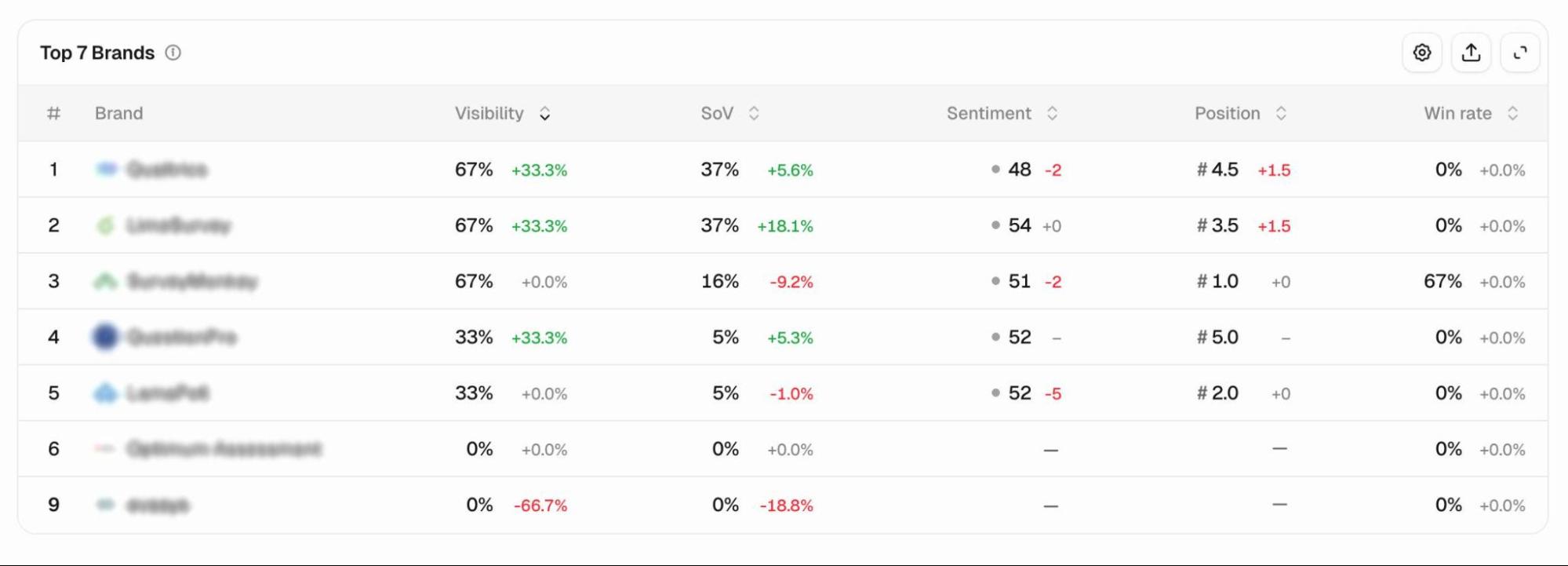
In Peec AI, that results in a project with your brand and a defined competitor set, a prompt set organised into topics and tags, a selection of models (for example ChatGPT, Google AI Overviews and AI Mode, Gemini, Perplexity, Claude or Copilot), and a country per prompt. Peec also auto-classifies prompts as branded or non-branded and by intent, which becomes important later.
Simple enough. The problems sit in the choices underneath.
There is no "accurate" AI visibility number
AI systems are probabilistic. The same prompt, in the same tool, on the same day, can produce a different answer, a different set of brands and different sources. Personalisation, memory, model routing and the search layer underneath add more variation.
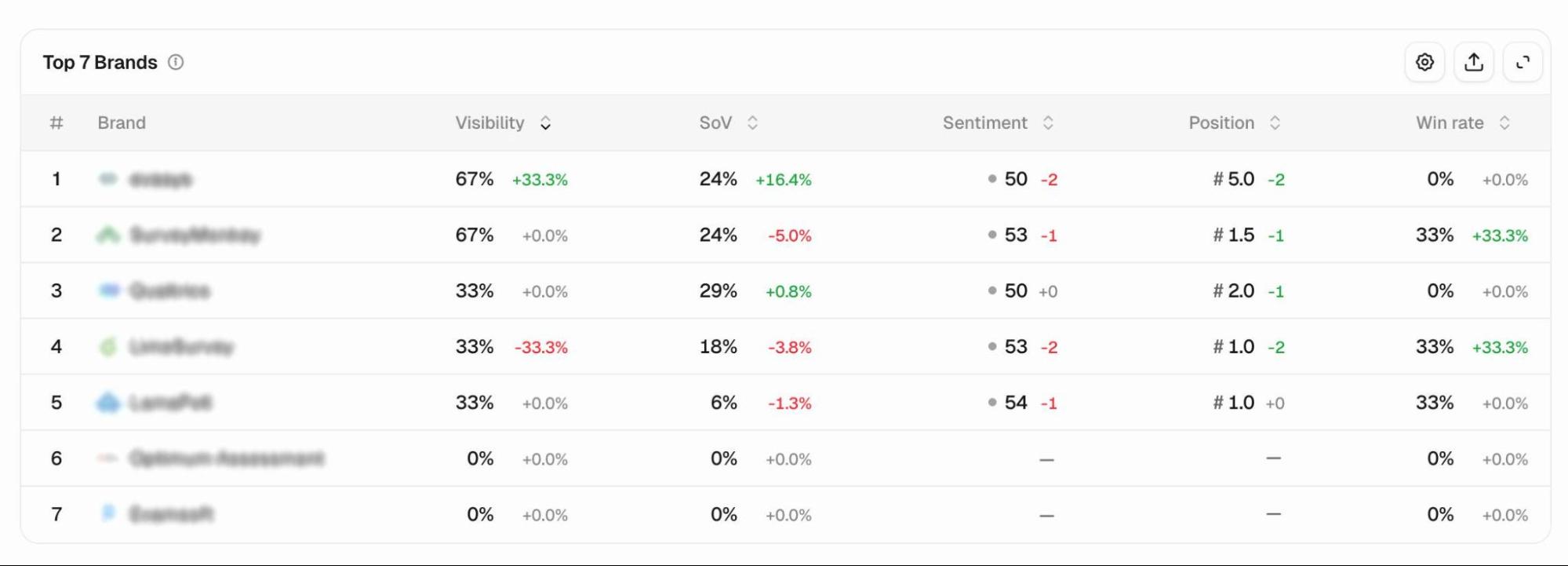
These two images represent results for the same prompt on two different days, within the same week.
So there is no single true answer to measure against. There is a distribution of possible answers, and every tracker samples from it. Mike King makes this case in his piece on accuracy vs precision in AI search tracking: when no true value exists, a tool cannot be accurate. It can only be precise, meaning consistent under the same conditions.
That turns a few methodological choices into part of the measurement itself:
- API vs interface: Querying a model through its API is not the same system as the consumer product a buyer uses. Google does not currently expose AI Overviews and AI Mode as an equivalent public response API for third-party prompt tracking. Trackers therefore use different collection or approximation methods.
- Logged in vs logged out: Logged-out sessions avoid personalisation, but they can run on a different model configuration than the one most real users see.
- Runs per prompt: One answer per prompt per cycle is a coin toss, not a measurement. More runs turn a yes/no into a rate with a margin of error.
- Mode: Fast and reasoning modes of the same model can cite very different sources. A Semrush study found only about a quarter of cited domains overlapping between ChatGPT’s Instant and Thinking modes.
Precise is not the same as meaningful
There is a second trap, and it gets far less attention. Stability across repeated runs proves that a setup is consistent. But, it does not prove that the prompt set reflects what real buyers ask, or that the score predicts anything.
A tool can give you a very stable, statistically relevant number for a prompt set that has little to do with your market.
Personal view: Treat your AI visibility setup like a research instrument, not a dashboard.
The metrics, and what each one actually tells you
No single AI visibility metric tells the full story. Each answers one specific question and misleads in specific ways.
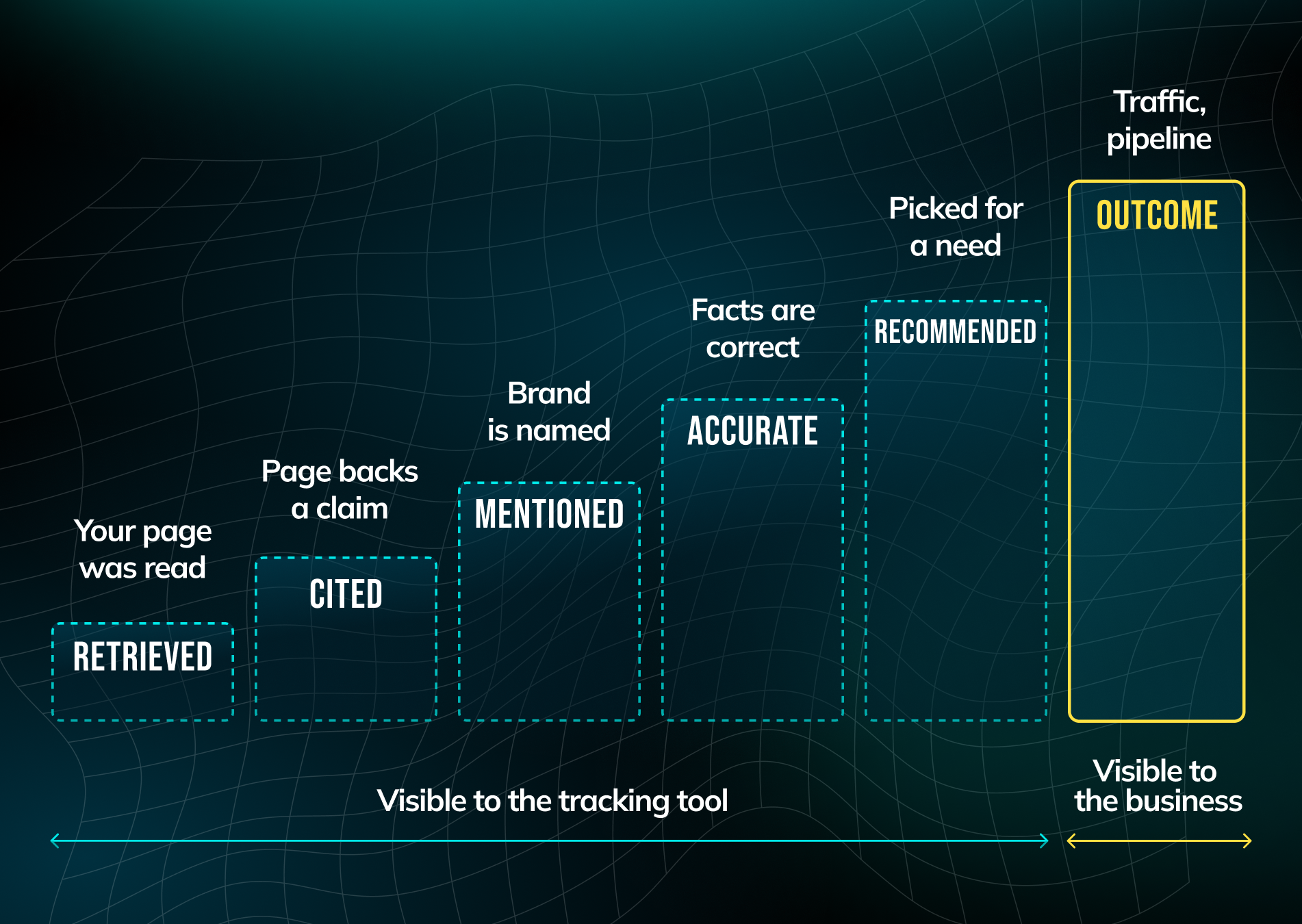
Start with a simple distinction. An AI answer can involve your brand in several separate ways, and you can win or lose each one independently:
- Retrieved: The AI system pulled your page into its context. The user never sees this.
- Cited: Your page is attached as the source for a specific statement.
- Mentioned: Your brand name appears in the answer.
- Represented accurately: What the answer says about you is correct and current.
- Recommended: You are suggested for a relevant use case, not just listed.
- Connected to an outcome: The visibility shows up in AI referral traffic, branded search, demos or pipeline.
Suganthan Mohanadasan's analysis of ChatGPT's network traffic shows how far apart the first three can be. In his sample, YouTube pages were fetched around 200 times and never cited once. Vendor pages were often cited for their own facts, like pricing, while the recommendation itself was sourced from third-party review sites. Daniel K Cheung adds the later steps: accuracy, recommendation and business outcome are separate signals and should be tracked separately.
The core metrics
{start-table}
Metric
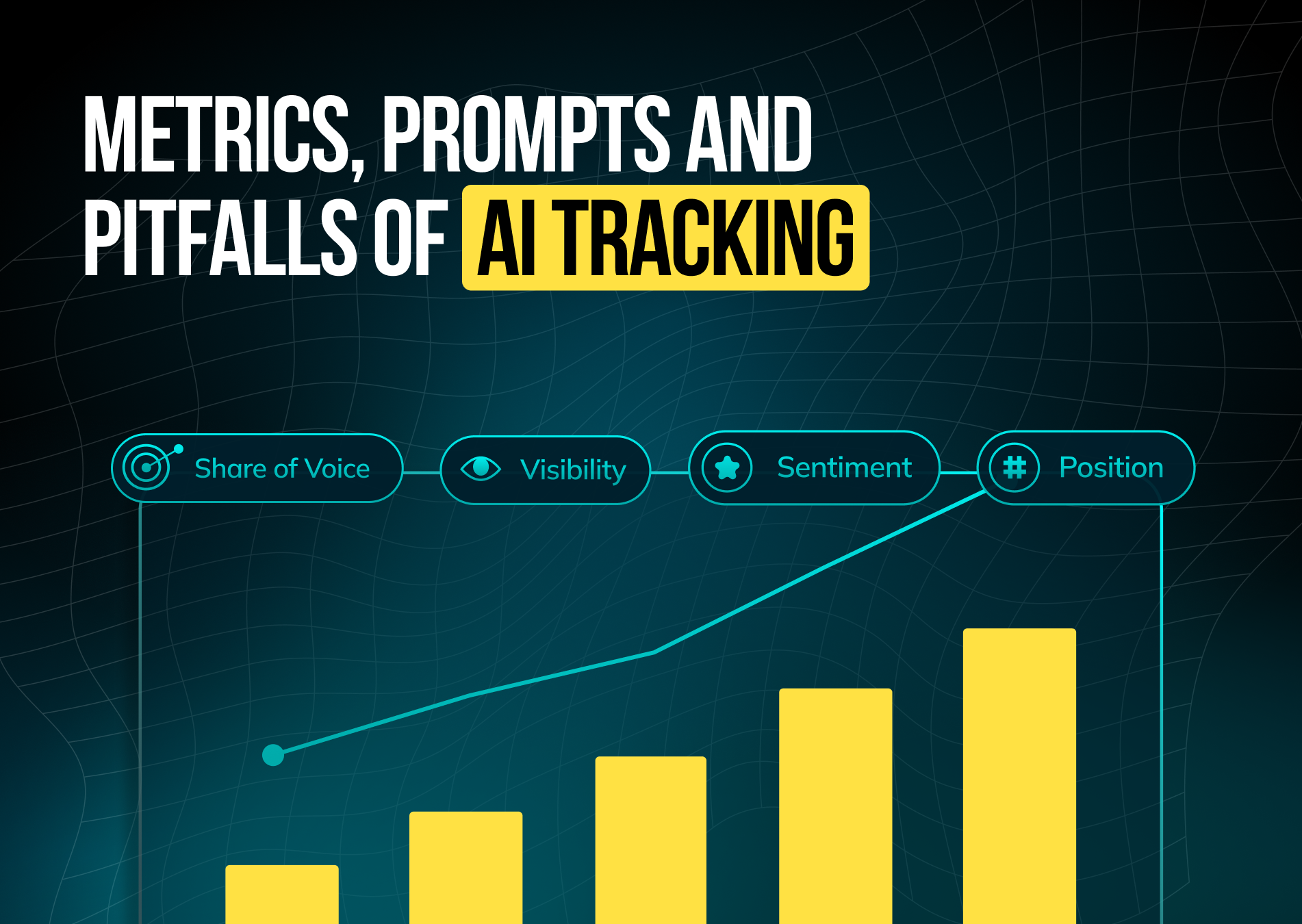
- Visibility (share of AI answers that mention your brand)
- Share of Voice (your mentions as a share of all tracked brands' mentions)
- Average position (rank when mentioned)
- Sentiment (tone of mentions, 0 to 100)
- Source metrics (how often your domains and URLs are retrieved and cited)
- Outcome metrics (AI referral traffic, AI crawler visits, self-reported attribution, pipeline)
What it answers
- How often are we in the answer at all?
- How much of the conversation do we own versus competitors?
- When we appear, are we the first suggestion or an afterthought?
- How are we described?
- Which pages feed the answers, ours or someone else's?
- Is any of this reaching the business?
How it is calculated
- Visibility score = (number of responses mentioning your brand / total responses) × 100
- SOV = (number of times your brand was mentioned) / (total number of brand mentions) × 100
-
-
-
-
When it misleads
- Inflated by prompts that name your brand or competitors. Blended across models, it hides where you are absent.
- Counted per mention, so answers about you inflate it. The denominator is only the competitors you chose to track.
- Only calculated when you appear, so a rare mention at #1 looks excellent.
- An average hides specific false or outdated claims..
- Retrieved is not cited, and cited is not recommended.
- Undercounted, but they measure real events.
{end-table}
Two counting questions to ask before you trust any metric
What is the unit? A mention can be counted per answer, per occurrence within an answer, per run or per prompt. In Peec, visibility counts answers, while Share of Voice counts mentions. That difference matters a lot, as the next sections show.
What is the denominator? Share of Voice is your share of mentions among the brands you track, not among all brands in the answers. Leave out a relevant competitor and your share rises without anything changing in the market.
Why AI visibility differs across search systems
The same prompts produce very different visibility across AI systems. A blended score hides exactly the information you need.
Each AI system has its own retrieval layer, its own preferred sources and its own habits. Some list many vendors, others name only a few. Some search the web for nearly every commercial question, others answer certain question types from training data alone. Multiple tests I ran internally showed that ChatGPT classifies a question before deciding whether to do web searches at all, and that wording alone can change that decision.
Here is what that looks like in practice. For Client A I tracked the same 89 unbranded prompts across four engines in September 2026. The category leader's visibility per engine:
{start-table}
AI engine
- ChatGPT
- Google AI Overviews
- Gemini
- Perplexity
Category leader visibility
- 44.9 %
- 41.0 %
- 35.6 %
- 17.6 %
{end-table}
Same prompts, same month, a 2.5x spread. Client A itself appeared in 2.7% of AI Overview answers and 0.7% of ChatGPT answers. In Gemini and Perplexity, it did not appear in a single one of 267 answers each.
Average all of that into one number and the most actionable finding in the data disappears: the brand is invisible on two of four engines.
Three recommendations:
- Report per model first, blended second. A blended number is a summary, not a KPI.
- Weight models by where your buyers are. If ChatGPT has a positive impact on the pipeline, drop in ChatGPT visibility might be way more important than to focus on increasing visibility in Gemini.
- Keep the model selection stable. In order to collect data that you can really use to measure progress, don’t change your models all the time.
Also check which mode your tool queries. As noted above, fast and reasoning modes of the same product can draw on very different sources. The Semrush study found that ChatGPT’s Thinking mode ran more than four times as many background searches as Instant mode, cited almost twice as many sources per answer, and pulled from nearly 100 domains that never showed up in Instant mode at all.
For the measurement, this means a tracker running only the fast mode may miss exactly the sources that matter in complex B2B evaluations, where buyers are more likely to use reasoning modes.
Personal view: For most B2B SaaS companies I work with, three or four models cover the buyers that matter. Tracking every available model rarely adds insight, but it reliably adds noise and cost.
{{cta}}
How to build a prompt set worth measuring
Your prompt set defines what your AI visibility number means. Build it from real buyer problems, not from your keyword list.
Prompts are not keywords. A keyword list approximates search demand. A prompt set is a sample of the questions buyers might ask an AI assistant, and every prompt you add changes what the final number represents.
The more useful approach is to track the problem statements that matter to specific buyer personas and industries.
Wording changes the result more than you think
Small changes in framing move results a lot. In Client A's set, two prompts address the same problem:
- "How can we streamline launching a new online shop?" → the category leader appears in 50% of answers
- "Why is launching a new online shop so time consuming?" → 17%
The solution-oriented framing pulls in vendor recommendations. The problem-oriented framing pulls in explanations. Both are legitimate buyer questions, but they measure different stages of the buying journey.
Count intents, not prompt rows
The same set also contained four near-identical prompts about preparing an online shop for the New Year. This situation doesn’t represent four valuable data points, but results in the inflation of averages, all based on the same (and single) intent.
A practical process
- Start with buyer problems. Pull problem statements from sales calls, CRM notes, lost-deal reasons, support tickets and long, question-style queries in Google Search Console.
- Map each prompt to a persona and a buying stage. For example problem identification, solution exploration and supplier selection. Tag both.
- Define current versus desired state. For each topic, write down what AI answers say today and what you want them to say. That gap is your strategy.
- Separate branded and unbranded prompts from day one. Use separate tags or even separate projects. More on why in the next section.
- Consolidate near-duplicates. One intent should be one prompt, or a deliberately designed cluster with a clear weight.
- Use realistic phrasing. Write prompts the way buyers talk to an AI assistant, with context and constraints, not like a three-word search query.
- Freeze the core set. Review it monthly or quarterly, not weekly, and annotate every change.
How your prompt set can manufacture your result
Prompts that name your brand will mention your brand. Mixed into the same report, they can make a nearly invisible brand look like a category leader.
This is the most common setup error I see, and the most expensive one, because it produces exactly the numbers people want to see.
Comparison prompts like "[Your brand] vs [Competitor]", or questions like "Is [Your brand] suitable for enterprise retail?", will mention your brand almost every time. That is not visibility. The user asked about you.
What it looks like in real data
Client A tracks 100 prompts across four AI engines. 11 of them name the brand: comparisons, suitability questions and capability checks. In September 2026, those 11 prompts produced a mention in every single answer. Here is what including them does to the headline numbers:
{start-table}
Metric
- Visibility
- Share of Voice
- Average Position
All prompts (blended)
- 11.7 %
- 25.6 % (rank 2 of 12 brands)
- 1.2 %
Unbranded prompts only
- 0.85 %
- 0.9 % (rank 8 of 12 brands)
- 3.0 %
{end-table}
11% of the prompts produced 94% of the visibility and 98% of all brand mentions.
On the blended dashboard, the brand looks like the number two player in its category, usually listed first. On the questions buyers ask before they know the brand, it appears in fewer than 1 in 100 answers.
Why Share of Voice inflates even more
Visibility counts answers. Share of Voice counts mentions. An answer about your brand names it again and again: Client A's branded answers averaged seven mentions each. In an unbranded answer listing ten vendors, you get one mention at best.
So branded prompts inflate Share of Voice even more than visibility. For Client A, blended Share of Voice was almost 30 times higher than unbranded.
The subtler version: prompts that name competitors
Client B has a more balanced setup. Answers to its own branded prompts make up only about 9% of the data. Still:
- Blended visibility: 32.0%
- Without own-brand prompts: 25.6%
- Without prompts that name competitors: 21.4%
The last step is easy to miss. Prompts like "best alternatives to [Competitor]" are automatically classified as non-branded, because they do not contain your brand name. But they are branded for someone. In that cluster, the named category leader appeared in 85% of answers and Client B in 48%, its best topic by far. The cluster inflates both brands.
The fix
- Report unbranded visibility as the headline KPI. It is the only number that shows whether AI systems recommend you to people who do not already know you.
- Tag every prompt that names any brand, yours or a competitor's, and check the automatic classification manually.
- Use branded prompts for what they are good at: accuracy, sentiment, positioning and objections. Is your pricing described correctly? Is a discontinued feature still mentioned? Which competitor are you compared to, and on which criteria?
- Never put a blended number next to competitors' numbers. Your branded prompts boost you, not them, so the comparison is tilted in your favour from the start.
Personal view: If a dashboard shows your brand ahead of the market leader, check the prompt set before you celebrate. The gap between blended and unbranded visibility is the first number I look at in every AI visibility audit.
Measuring visibility at product and service level
A brand-level visibility number averages away the decisions you actually need to make.
Most B2B SaaS companies do not sell one thing to one buyer. They have product lines, use cases, segments and markets, each with its own competitor set. A single brand-level number tells you very little about any of them.
The brand-level average would have led to a generic initiative to "improve AI visibility". The breakdown tells us where: for example early-stage discovery and hybrid workflows, not the cost and comparison topics that might have been prioritised by instinct.
How to set it up
- One topic per product line or use case. In Peec, topics work well for the main split, since each prompt belongs to exactly one. Use tags for cross-cutting dimensions such as persona, buying stage, market and priority.
- Use product-specific competitor sets. Your competitor for one product is often not your competitor for another. Share of Voice only means something against the right set.
- Map cited URLs to the right pages. Check which of your pages get retrieved and cited per topic. If answers about a product cite your homepage or a competitor's comparison page instead of your product page, you have a content or structure gap.
- Track markets separately. The same prompt in Germany and in the US are two different measurements, often with different sources behind them.
Reading the data without fooling yourself
AI visibility data is noisy by nature. The goal is not only to remove the noise, but to stop reacting to it.
Validate against real outcomes
The only true numbers in this system live outside the tracker: AI referral sessions, AI crawler and agent visits in your log files, branded search demand, "how did you hear about us" answers and pipeline. They are undercounted, but they describe events that actually happened.
If your visibility rises for six months and none of these move, the tracker is not necessarily wrong. It may be measuring prompts that do not matter to your business, which is an even more important finding.
Review cadence
- Weekly: Accuracy of answers on branded prompts and obvious errors
- Monthly: Unbranded visibility per model and topic, sources and citation gaps
- Quarterly: Prompt set, topic structure, competitor set and model selection
- Continuously: AI referral traffic, branded search and pipeline as the validation layer
8 questions to ask before you trust any AI visibility dashboard
You do not need a statistics degree to judge an AI visibility setup. You need to ask the right questions, of your vendor and of your own team.
McSweeney's 31 questions is one of the most thorough methodology checklists I know of, and worth reading in full. Here is a condensed version for leaders who need to judge a number in a meeting:
- How many runs per prompt is this number based on? One run per prompt per cycle is a snapshot, not a rate.
- Which models and modes are included, and how are they combined? Equal weights, usage-based weights or simply the number of prompts per model?
- What share of prompts name our brand or a competitor? And are they included in the headline number?
- What counts as a mention? Answers, occurrences or links? How are product names, aliases and ambiguous brand names handled?
- What is the Share of Voice denominator? All brands mentioned, or only the competitors we selected?
- How are failed or empty answers counted? When a model refuses, times out or does not search, is that "not visible" or excluded?
- Are changes to the setup marked on trend charts? New prompts, model updates, changed extraction rules?
- Has the score ever been compared to something external? AI referral traffic, branded search or pipeline. A score that has only been validated against itself is not yet a measurement.
Lorem ipsum dolor sit amet
Lorem ipsum dolor sit amet, consectetur adipiscing elit. Suspendisse varius enim in eros elementum tristique.
Strong visibility score, but little impact on pipeline?
Our Organic Growth and Content experts help you find where your buyers actually discover you in AI answers, then build the content strategy that gets you seen there.
THe Bottom Line
Measure your setup before you measure your brand
AI visibility tracking is worth doing, but only if the setup behind the number is worth trusting.
Tracking is one of the few ways to see how AI systems describe your category, which competitors they associate with your buyers' problems and which sources shape those answers.
But the number is only as good as its design. Prompts that name your brand inflate it. Blended models hide where you are absent. Single runs turn noise into trends. Brand-level averages hide product-level decisions.
So before you report AI visibility to your board, make sure you can explain what it represents. Separate branded from unbranded. Report per model and per product. Count intents, not rows. And connect the number to something that happens outside the tool.
The goal is not a high score. It is a score you can make decisions with.
Your questions answered
Is AI visibility tracking accurate?
Not in the classic sense, because there is no single true answer to measure against. AI systems generate different answers across runs, models and users. What a good setup can deliver is consistent, repeatable measurement on a well-designed prompt set, validated against real outcomes such as AI referral traffic and pipeline.
How many prompts should I track?
There is no universal number. What matters more is how many independent buyer intents your set covers and how many times each prompt runs. For most B2B SaaS companies I work with, 50 to 150 well-designed prompts, split by product, persona and buying stage, is a workable range. A smaller set with more runs per prompt is usually more useful than a large set with one run each.
Should I track branded and comparison prompts at all?
Yes, but separately. Branded and comparison prompts are valuable for checking accuracy, sentiment, positioning and how you are compared to competitors. They should not be part of your headline visibility number, because answers to questions about your brand will almost always mention it.
Which AI systems should I track?
Start with the systems your buyers actually use. Your AI referral traffic by source is a good indicator. For most B2B companies, that means ChatGPT and Google AI Overviews or Claude. Or if ICP is a traditional EU corporation I tend to add Copilot to the mix. Report each one separately before looking at any blended number.
How do I connect AI visibility to the pipeline?
Treat visibility as a leading indicator and validate it against lagging ones: AI referral sessions and conversions, branded search demand, self-reported attribution in forms and sales calls, and influenced pipeline. If visibility and these signals do not move together over time, revisit your prompt set before you revisit your content.