
Content
Most B2B marketers getting into AI Search Optimization, also known as Generative Engine Optimization (GEO) or Answer Engine Optimization (AEO), are starting with the wrong question: "How do I rank my content in ChatGPT?"
But AI Search isn't simply another search engine. The real question you should be asking is: “How do I ensure my content influences buying decisions when buyers increasingly use AI to research vendors, compare solutions, and evaluate options before ever visiting my website?”
Big difference!
Traditional SEO often focused on generating clicks. AI Search rewards brands that become visible, trusted, and cited throughout the buying journey, even when no click happens.
In this article, I'll show how B2B companies can optimize content for AI Search in a way that drives pipeline and revenue, not vanity visibility metrics.
TL;DR:
How do you optimize B2B content for AI Search?
To optimize B2B content for AI Search, focus on becoming a source AI systems trust and cite. Cover the entire buyer journey, create content that directly answers buyer questions, build topical and entity authority, publish original insights and data, and ensure your content is easy for AI systems to crawl and understand. Success should be measured through AI visibility, demand generation, and revenue impact rather than rankings or traffic alone.
The biggest mistake: Treating AI Search like Google SEO
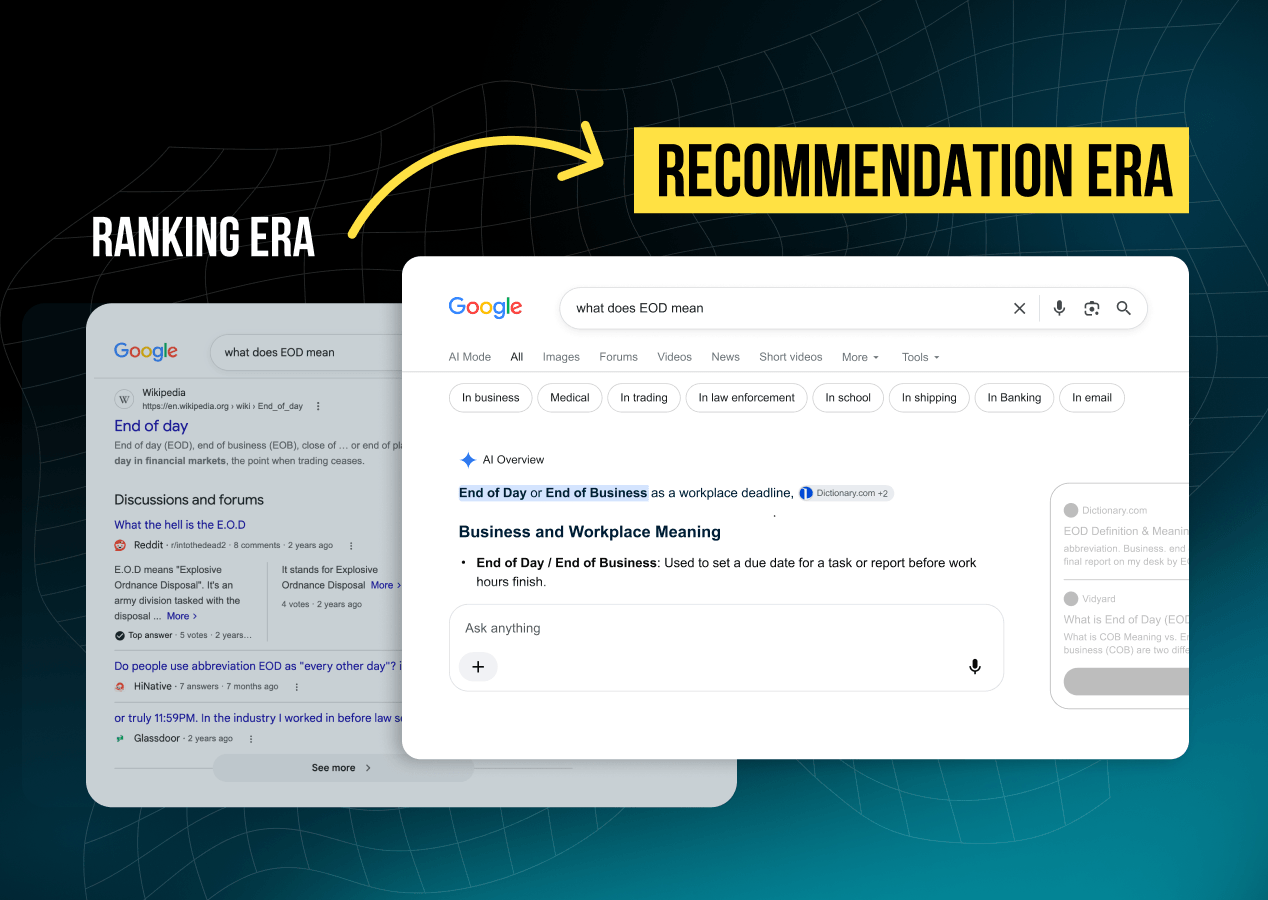
The biggest mistake B2B marketers make with AI Search is applying traditional SEO logic to a system that works nothing like Google. LLMs don't return rankings. They return trusted answers, and that distinction changes everything.
AI Search is not the next version of Google
LLMs are not search engines. They are personal assistants, researchers, friends to some, but they are definitely not a traffic channel. Users interact with these systems completely differently than they did with Google. Therefore, treating them like it doesn't make sense.
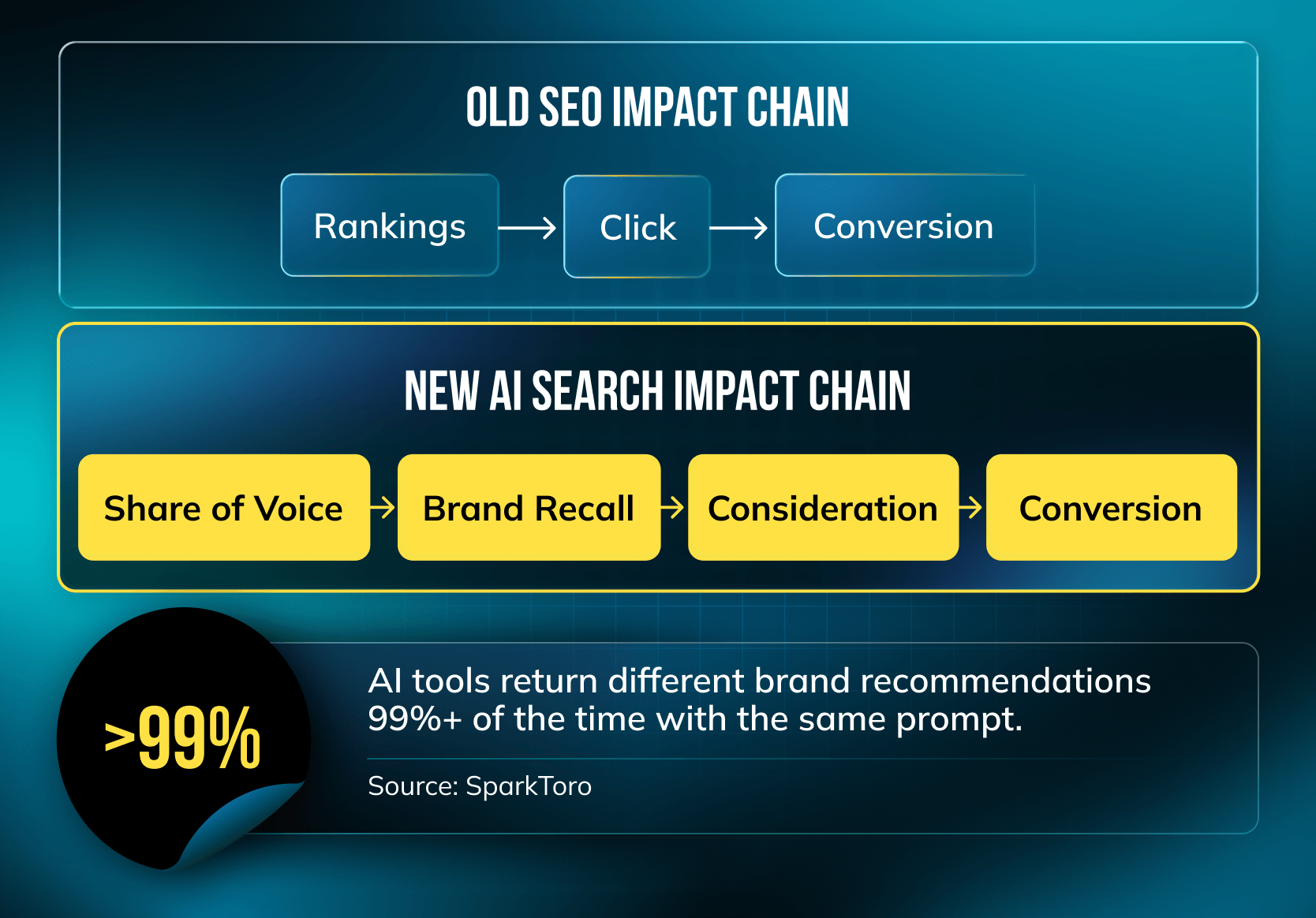
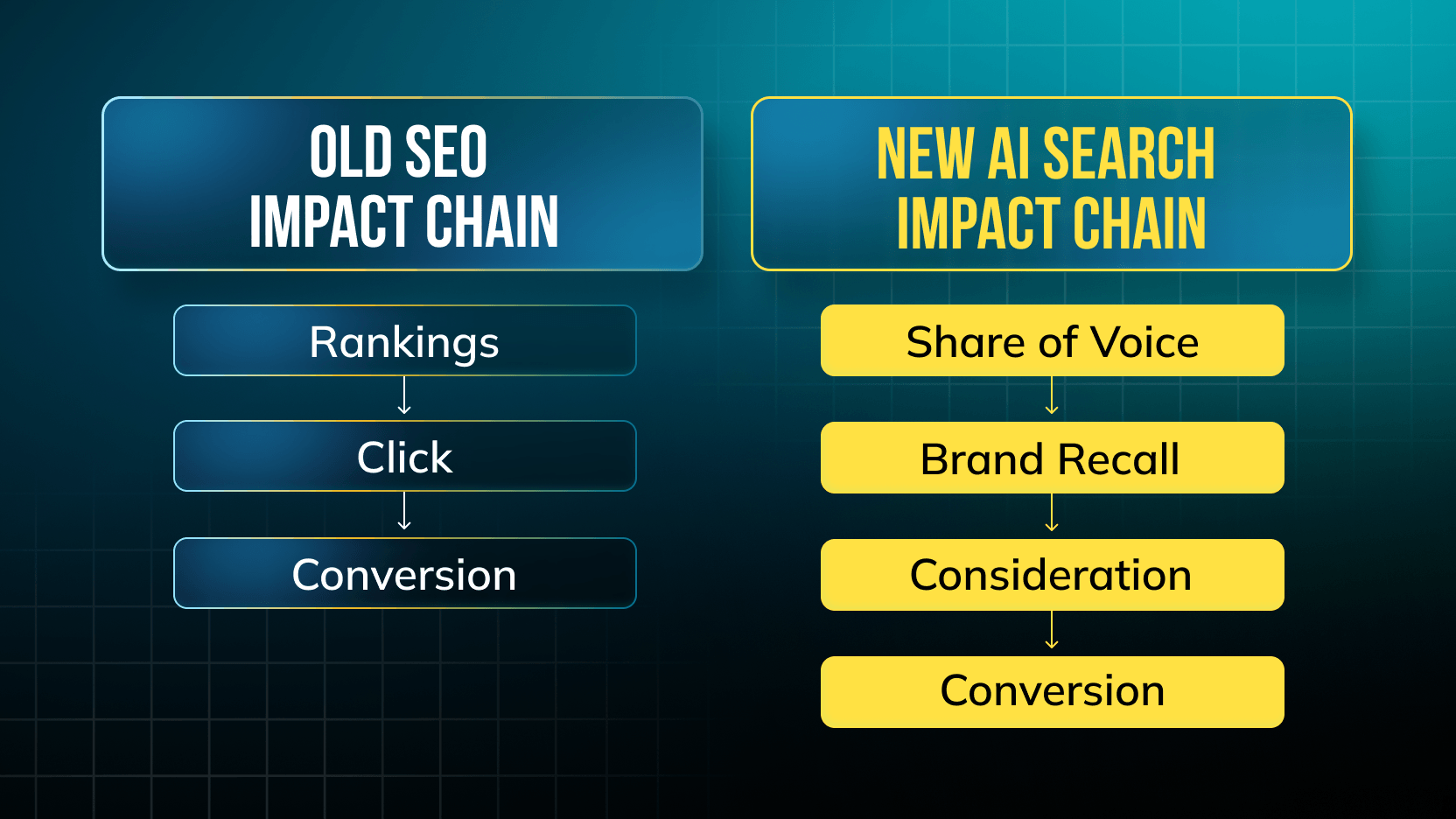
For years, organic growth teams relied on a relatively simple model: Visibility (Rankings) → Click → Conversion
But AI Search breaks this chain.
Users now get answers directly inside AI Overviews, ChatGPT, Gemini, and Perplexity. They compare vendors, evaluate solutions, and build shortlists without ever visiting a website. As a result, traffic and click-through rates are becoming less reliable indicators of marketing performance.
At the same time, AI visibility cannot be measured like traditional rankings. Unlike Google, there is no universal "position #1". Responses are personalized, contextual, and constantly changing.
In fact, a study by SparkToro found that AI tools returned a different list of brand recommendations more than 99% of the time, even when given the exact same prompt.
This means ranking reports alone tell you very little about your actual visibility.
The companies that win in AI Search won't be those chasing rankings. They will be the brands that consistently appear across buyer conversations, comparison prompts, recommendation requests, and research journeys.
The new impact chain looks more like this: Share of Voice Across the Web → Brand Recall → Consideration → Conversion
This is why AI Search should not be viewed as a traffic channel. It is a visibility and influence channel. The goal is no longer to generate a click but to shape the buying decision before the click ever happens.
The key takeaway is simple: Content optimized for AI Search must influence decisions, not just attract traffic.
Traditional SEO vs AI Search Optimization
{start-table}
Traditional SEO
- Rankings
- Keywords
- Clicks
- SERPs
- Position #1
- Traffic
- Sarch visibility
AI Search Optimization
- Citations
- Buyer prompts
- Influence
- AI-generated answers
- Recommendation frequency
- Share of Voice
- Brand visibility
{end-table}
This doesn't mean SEO is dead. It means the success metrics are evolving. The companies that win in AI Search are often the same companies that have strong SEO foundations, but they go one step further and become trusted sources that AI systems repeatedly reference.
The AI Search Optimization framework for B2B content
Most AI Search advice focuses on hacks, prompts, or technical tricks.
In reality, the brands winning in AI Search create content that helps AI systems understand, trust, and recommend them throughout the buyer journey.
Here's a practical framework we use at YOYABA when helping B2B software companies improve their visibility in AI Search.

1. Become the source, not another summary
Why should an AI system reference your content instead of hundreds of similar articles?
As AI-generated answers become a larger part of the buyer journey, visibility depends less on holding a specific ranking position and more on being considered a trustworthy source. In fact, multiple studies have shown that AI systems frequently cite pages that do not rank at the top of traditional search results (searchenginejournal).
The brands that consistently appear in ChatGPT, Perplexity, Gemini, and AI Overviews are often not the ones publishing the most content. They're the ones creating information that others reference.
Build entity authority
- AI systems evaluate more than pages. They evaluate brands, authors, and companies.
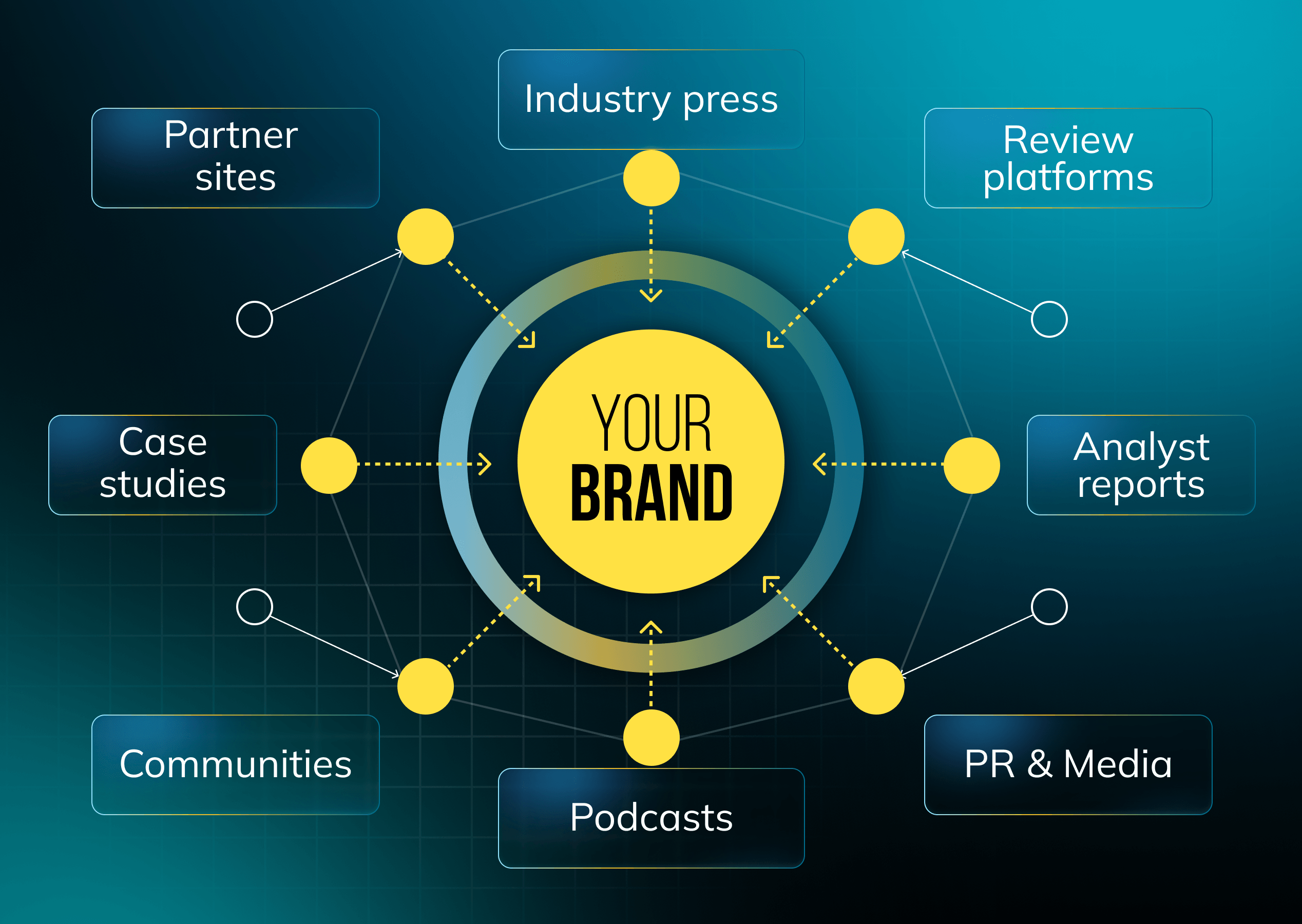
- The more frequently your brand appears across trusted sources such as industry publications, reviews, podcasts, analyst reports, community discussions, and PR coverage, the more likely AI systems are to view you as a credible authority.
- Third-party validation, including reviews, mentions, citations, partnerships, and external references, is a strong trust signal for both search engines and AI systems (Discovered Labs).
Increase topical density
- Publishing a few isolated articles is rarely enough.
- AI systems tend to trust websites that demonstrate deep expertise across an entire topic. Instead of creating one article, build a cluster of related content that covers a topic from multiple angles. The goal is not to publish more content. The goal is to own a topic.
Publish original insights and data
- The easiest way to become a source is to create information that doesn't exist elsewhere.
- Content that is frequently cited by AI systems often contains:
- Original insights, frameworks, and perspectives (blog.google)
- Data and statistics that support claims (Averi)
- Case studies and real-world examples that demonstrate experience (bluearcher.com)
- Expert perspectives and clearly attributed expertise (bluearcher.com)
Ultimately, AI systems need sources. The strongest AI Search content combines expertise, evidence, clarity, and trust signals, giving AI systems a reason to reference your content instead of simply summarizing someone else's.
2. Identify and cover content gaps across the buyer journey
AI systems don't just surface content when buyers are ready to purchase. They influence decisions long before someone visits your website.
To join and influence these conversations, start by mapping your existing content against the key stages of the buying journey:
- Problem Awareness
- Problem Identification
- Solution Exploration
- Supplier Selection
- Decision
Then ask yourself: Which questions can buyers ask AI systems at each stage that your content currently doesn't answer?
For example:
- Problem Identification
- Why is our team struggling to scale efficiently?
- What causes low conversion rates in B2B SaaS?
- Solution Exploration
- What are the best CRM systems for growing B2B companies?
- How do companies improve pipeline forecasting?
- Supplier Selection
- HubSpot vs Salesforce
- Best CRM for B2B SaaS companies
- Alternatives to [Competitor]
- [Vendor A] vs [Vendor B]
- Reviews of [Vendor]
The biggest opportunities often sit in Solution Exploration and Supplier Selection, where buying intent is highest. Once you've identified your gaps, analyze which websites and content formats are already being cited in AI systems for those topics.
Reverse engineer:
- Content structure
- Depth of coverage
- Sources referenced
- Page format
- Types of evidence used
BUT don't just copy them. Understand why AI systems trust them and then improve on that.
3. Make content AI-readable with structured content for AI
AI cannot cite what it cannot understand. Structure your content so both humans and machines can quickly extract key information.
Use a logical hierarchy
- One clear H1
- Descriptive H2s
- Supporting H3s
- Headings should mirror the questions your buyers actually ask.
Answer first, explain second
- Start each section with a concise answer.
- Then provide:
- Context
- Detail
- Examples
- Evidence
- Think: Answer → Explanation → Proof, rather than long introductions before delivering value.
Make content machine-readable
- Content is accessible without JavaScript rendering
- Important information exists in the HTML
- Pages are easy to crawl and parse
- Key information is not hidden behind tabs or interactive elements
- The easier your content is to process, the easier it becomes for AI systems to cite and recommend it.
Implement relevant Schema.org markup such as:
- Article
- FAQPage
- HowTo
- Organization
- Product
- SoftwareApplication
This tactic has the highest overlap with SEO. If you have already optimized your content for SEO, you may not have much to do here.
4. Support with strong technical foundations
Even the best content cannot be cited if AI systems struggle to access it. Make sure your website is easy to crawl, parse, and index. At a minimum:
- Maintain a clean robots.txt file
- Keep XML sitemaps updated
- Use canonical tags correctly
- Avoid unnecessary crawl barriers
- Ensure pages load quickly
- Keep important content publicly accessible
Most importantly: AI systems cannot recommend content they cannot reliably retrieve.
{{cta}}
Measure the right content KPIs: Traffic is becoming a vanity indicator

One of the biggest mistakes marketers make when evaluating AI Search performance is using traditional SEO KPIs like traffic.
Users increasingly get answers directly inside AI Overviews, ChatGPT, Gemini, and Perplexity. They compare vendors, build shortlists, and evaluate solutions without ever clicking through to a website.
As a result, traffic can decline while business outcomes improve.
We've seen companies increase organic signups, qualified leads, and pipeline while website traffic remained flat or even declined. The reason is simple: AI Search influences buying decisions long before a click occurs.
This means marketers need a new measurement framework.
The new model looks like this: Found → Remembered → Chosen
A buyer may first encounter your brand in an AI-generated answer, see it again in a comparison article, hear it mentioned in a podcast, and only visit your website weeks later when they are ready to engage.
The new framework looks like this:
{start-table-big}
Topic | Visibility | Demand | Revenue
Question
- Can buyers discover us through AI systems?
- Is visibility creating interest and intent?
- Is AI visibility influencing business outcomes?
Metrics
- AI citations || Share of Voice across AI platforms || Visibility in AI Overviews || Presence in commercial and comparison prompts || Visibility versus competitors
- Branded search volume growth || Demo requests || Free trial signups || Newsletter subscriptions || Contact form submissions || Other hand-raiser conversions
- Pipeline influenced by organic and AI-driven channels || Sales Qualified Opportunities (SQOs) || Self-reported attribution || Revenue sourced from organic channels || Closed-won revenue
{end-table-big}
But don't measure metrics in isolation. No single KPI will tell you whether your AI Search strategy is working.
- Visibility without demand is vanity.
- Demand without revenue is incomplete.
- Revenue without visibility is difficult to scale.
The most effective teams connect all three layers: Visibility → Demand → Revenue
When these metrics move together, you gain a much clearer understanding of how AI Search contributes to business growth.
Lorem ipsum dolor sit amet
Lorem ipsum dolor sit amet, consectetur adipiscing elit. Suspendisse varius enim in eros elementum tristique.
Want to increase your AI visibility?
AI Search rewards companies that become trusted sources, not those chasing rankings. Our Organic Growth, SEO & GEO Services help B2B companies build authority and visibility across search and AI platforms, while our Content Marketing Services help create the original insights, topic coverage, and buyer-focused content that AI systems are more likely to cite and recommend.
THe Bottom Line
AI Search is changing how B2B buyers discover, evaluate, and select vendors.
The companies that win won't be the ones producing the most content but content that AI systems can understand, trust, and recommend throughout the buyer journey.
Focus on covering buyer needs, creating citation-worthy content, building strong technical foundations, and measuring business impact instead of clicks.
Your questions answered
What content gets cited most often by AI search engines?
Content that gets cited most frequently tends to combine clear answers, expert perspectives, original insights, proprietary data, case studies, and third-party validation. AI systems are more likely to reference sources that provide unique information rather than content that simply summarizes existing knowledge.
What is AI Search Optimization?
AI Search Optimization is the process of improving how often your content, brand, and expertise are cited by AI-powered search experiences such as ChatGPT, Perplexity, Claude, Gemini, and Google AI Overviews.
Is AI Search Optimization different from SEO?
Yes. Traditional SEO focuses primarily on rankings and clicks. AI Search Optimization focuses on citations, visibility, authority, and influence within AI-generated answers.
How do I optimize content for AI Search?
The most effective approach combines:
- Strong SEO fundamentals
- Clear content structure
- Buyer journey coverage
- Entity authority
- Topical expertise
- Original research and data
What is Generative Engine Optimization (GEO)?
Generative Engine Optimization (GEO) is another term for AI Search Optimization. It focuses on improving visibility within AI-generated answers rather than traditional search engine rankings.
How do I get cited by ChatGPT and Perplexity?
While no guaranteed method exists, content that gets cited frequently often includes:
- Clear answers
- Expert perspectives
- Original insights
- Data and statistics
- Case studies
- Third-party validation
Does schema markup help AI Search visibility?
Schema markup helps AI systems understand your content more accurately. However, schema alone is unlikely to make your content appear in AI-generated answers without strong authority and useful content.
What metrics should I track for AI Search?
Focus on:
- AI citations
- Share of Voice
- AI Overview visibility
- Branded search growth
- Pipeline influence
- Sales Qualified Opportunities (SQOs)
- Revenue
rather than relying on traffic alone
Is AI Search replacing SEO?
No. AI Search is becoming an additional discovery layer. The strongest B2B marketing strategies combine SEO, content marketing, brand building, and AI Search Optimization.
.png)