Content
What I learned building YOYABA’s first OpenAI ad
The first time I opened OpenAI's ad manager, I sat there for a few minutes not knowing what exactly I was supposed to do. The platform looked simple enough to speed up the learning process, and unfamiliar enough to slow it right back down.
Every concept I knew, like keywords, audience building, and location targeting, had little to no presence here. All I saw was a box asking me to describe, in plain English, the kinds of conversations I wanted our ads to show up in.
The years I'd spent in paid advertising had not prepared me for this. So I did the only thing that ever actually helps: I stopped staring and dived right into it.
We ran YOYABA's first ChatGPT ad in June 2026, a month after OpenAI opened self-serve advertising to everyone. This is an account of what I expected, what the platform looks like on the inside right now, what my initial impressions are, and whether I think running these ads is worth your time. If you're a B2B marketer who knows ChatGPT ads exist but hasn't touched the platform yet, let this field report walk you through one B2B agency's first real experience with AI advertising.
TL;DR:
Are ChatGPT Ads worth it?
In June 2026, we were one of the first agencies to actually run a ChatGPT Ads campaign, for a US legal-tech SaaS and with a small budget that we deliberately treated as a learning investment.
The platform works completely differently from Google: no keywords, no audiences, just Context Hints. These are natural-language descriptions that match on the meaning of the conversation. The ad then shows up as a labeled card below the ChatGPT response.
Our first take: even though it's still early (one campaign and barely ten days of data), the initial signals on the channel's efficiency are promising.
Main takeaway: right now this is a top-of-funnel channel and not a Google replacement, but a complement. Conversion bidding is still missing for now. The real win is the head start on writing Context Hints while things are still quiet here.
Why we tried advertising inside ChatGPT in the first place
B2B buyer research is shifting from Google to AI chatbots, so we got hands-on with ChatGPT ads early rather than wait for the data to prove it out.
B2B buyers now start their research in ChatGPT, not Google
ChatGPT ads do come across as the shiny new toy everyone wants to play with, but a lot of it has to do with how "searching" for anything is rapidly changing. The research for "best tools for X" or "alternatives to Y" that largely happened on Google is now shifting to AI chatbots.
According to G2's 2025 buyer behavior report:
- 51% of B2B software buyers now start their research with an AI chatbot rather than a search engine.
- ChatGPT is the one they reach for most, at 63%.
- 69% said AI guidance led them to a different vendor than they'd originally planned, and one in three bought from a company they'd never heard of before the chatbot surfaced it.
The truth is that buyers are quietly moving to AI. They ask ChatGPT to compare vendors, summarize options, and shortlist before they ever sign up for a product. There are a lot of high-intent considerations happening in those conversations that we couldn't reach. The chance to advertise on ChatGPT meant we could finally place ourselves inside them.
Why we ran a real campaign instead of waiting
Our goal was simple: get into the platform, actually run something, learn the mechanics, and find out if the intent quality lived up to the theory. Most agencies are still theorizing about this channel. We'd rather be one messy campaign and a few hundred dollars ahead of that conversation, because that's the kind of experience you can't get from a YouTube tutorial or a webinar.
Hence, we treated it like we treat any new channel: an experiment with a small, ring-fenced budget, set on top of the client's core spend rather than taken out of it. We capped it at about 3% of the account's monthly budget with the goal of learning the platform's mechanics. You don't need much to get going, either. OpenAI dropped its minimum spend in May 2026, so you can start at around $20 to $50 a day.
If you're thinking about testing ChatGPT ads: plan for experiments like this as a standing line in your budget, say 5 to 10% of paid spend, and judge them on what you learn, not what they convert.
Choosing the right client to test with
For our first ChatGPT ads campaign, we picked a US B2B SaaS company in legal tech, with a clear action we could track: a qualified signup. What made them a good fit was a defined audience segment and a clear conversion path we could measure. While we didn't have hard evidence their buyers were already on ChatGPT, finding out was part of the experiment.
Taking a tour of the OpenAI advertising platform
Here comes the fun part. If you've been trying to figure out how to run ads on ChatGPT, the first surprise is the setup itself: the OpenAI Ads Manager works differently from the platforms you're most likely familiar with, like Google, Meta, or LinkedIn. A lot of the fundamentals still apply, you're still thinking about who you're reaching and what makes them act. What changes is the mechanics, and that's what trips you up.
No keywords, no audiences, just context hints
You can't bid on "serve legal documents" and compete for impression shares. There aren't any audience segments either: no job titles, no interests, no behaviors, no retargeting audience to target.
Instead, you write context hints, which are plain-language descriptions of the kind of conversations you'd like your ads to show up alongside. The matching happens on the meaning of the conversation, not on a string of keywords.
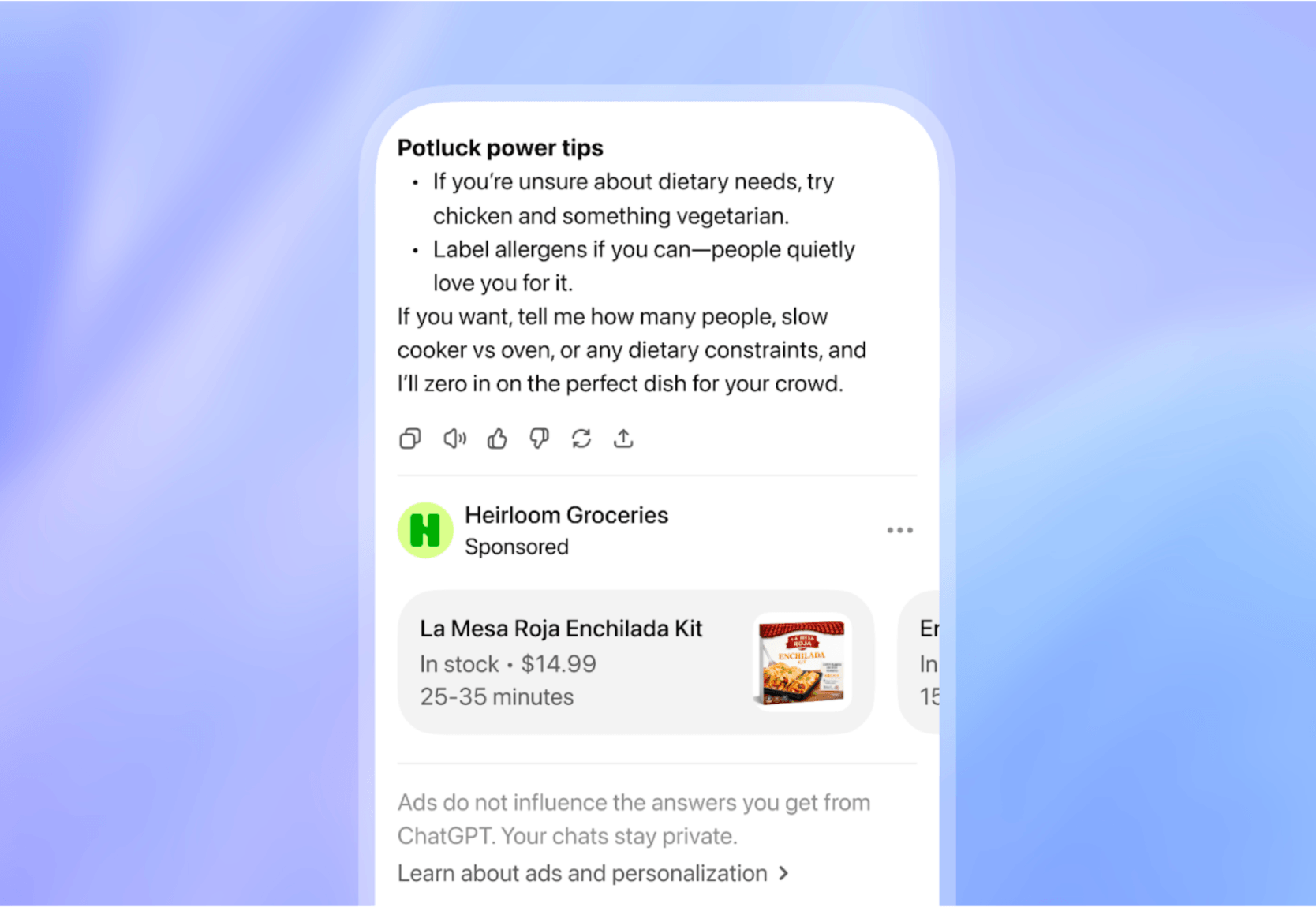
When your ad does serve, it shows up as a sponsored recommendation card underneath ChatGPT's answer. It's clearly labeled as an ad and visually separated from the response, so there's no pretending it's organic.
The big limitation: You can't bid for conversions yet
You can only bid for reach or CPC; bidding for conversions hasn't launched yet. You can still track conversions in your CRM after the click. What you can't do yet is tell ChatGPT to go find more of the people who convert. So measurement works, but optimization doesn't, yet. The platform is in beta, and this is where that shows most.
Another limit worth knowing: the ads only serve in a handful of markets as of June 2026: the US, Canada, Australia, New Zealand, the UK, Japan, and South Korea. If your buyers sit outside those countries, they're not within your reach yet.
One thing I'd like to see as the OpenAI advertising platform develops is negative context hints, mirroring the negative keyword list on Google. That would let us exclude conversations we don't want to appear in. For example, a few we'd happily skip are someone asking how to do the task themselves for free, a student researching the topic for a paper, or a job seeker looking for work. Right now there's no way to exclude any of it, so you pay for those clicks regardless.
Writing context hints is a different job than writing ad copy
This is where things got a little tricky for me. Since the platform is so new, there are no standardized guidelines for how to approach ChatGPT ads context hints, what works and what doesn't. For me, this was mostly educated guesswork.
Unlearning the keyword mindset
My initial approach was the one I'd use for a keyword list: tight, specific, intent-loaded. My first hints read like search queries dressed up in a sentence, short and transactional, basically "person wants to buy this now." That was until I dug into what OpenAI themselves had to say.
According to their setup guide, this is what they recommend: your context hint should be specific enough to describe a user's need, but broad enough to match the natural flow of the conversation, using the kind of language people actually use.
It offers more pointers on framing a good context, but that one made things click. People don't arrive at ChatGPT mid-purchase. They arrive mid-problem. They describe a situation, ask for help thinking it through, and only later get to anything resembling a decision.
How to actually write a context hint
Using that, here's how I built my context hints:
- Describe the audience: who are they, what do they do?
- Name their intent: what are they actually looking for?
- Connect your solution: what can your product offer them?
Say you sell expense management software. An example of a context hint could be: "Finance leads and operations managers at small to mid-sized companies who are tired of chasing receipts and reconciling expenses in spreadsheets, and want a faster way to track, approve, and report on company spending." It names who they are, what's frustrating them, and what you solve, without a product name or a single keyword in sight.
The shift sounds small, but it took real unlearning. You're describing a moment in someone's day accurately enough that the platform recognizes it, and the quality of that description is the most important part of the job.

What ten days and one campaign taught us
The easiest thing in the world to do is to over-read early data, and the second easiest thing is to ignore its caveats.
Over the first ten days, the campaign spent about $529, served roughly 15,900 impressions, and drove 173 clicks. That's a click-through rate of around 1.1%, a cost per click of about $3.06, and a CPM of roughly $33. It ran at a steady pace, roughly $53 a day.
That's a fairly low CPM, and it makes sense: not many advertisers are bidding here yet, so it's cheap while it lasts. Expect that to change as more of them move in.
You might also wonder: is a 1.1% CTR good? Honest answer: we don't fully know yet. Compared to the same client's other channels, it's on the lower side, but that's an apples-to-oranges comparison. The platform setup is different, and the way the ads are placed and served is different from search engines and social feeds. The current average CTR for ChatGPT ads sits at 0.68%, so against the only benchmark that's actually comparable, our 1.1% is running well above the platform norm.
In its current state, ChatGPT advertising is mainly a top-of-the-funnel tool
The CPC-or-reach bidding constraint isn't a footnote. It decides what ChatGPT ads are good for today.
We can see the conversions that come through, but we just can't tell the platform to go find more of them yet, since there's no conversion-based bidding. As mentioned, it's still in beta, so for now we use the channel for what it does best: putting our client in front of high-intent research conversations at the top of the funnel.
To judge success at this stage, look at impressions and clicks, and what shows up in your CRM afterward. Pair it with the channels that already convert.
How do ChatGPT ads fare against Google ads?
There's no real comparison here. ChatGPT and Google ads do different jobs, and right now they're not close to being interchangeable.
Google captures demand that already knows what it's searching for. ChatGPT reaches the user mid-thought, before it's resolved into a clean query, and it does it by matching the conversation context rather than just the keywords. This is a whole new kind of ad space.
The bigger difference is how and where the ads are placed. People are familiar enough with Google to know where the sponsored results are and how to skip them. In ChatGPT, as mentioned, the ad shows up as a sponsored card at the end of the conversation, which makes it read as a suggestion rather than an interruption.
Here's the ChatGPT ads vs Google ads picture for B2B, side by side:
{start-table}
Kategorie
- Targeting
- Buyer mindset
- Placement
- Bidding
- Best for
ChatGPT Ads
- Context hints (plain language)
- Mid-problem, still deciding
- Sponsored card below the answer
- CPC or reach only (beta)
- Top-of-funnel reach
Google Ads
- Keywords and audiences
- Knows what they want
- Sponsored results on the SERP
- Full funnel, including conversions
- Demand capture, conversions
{end-table}
This is why we don't really see it as Google versus ChatGPT. They catch buyers at different moments, one when they're ready to act and one while they're still making up their mind. For now we're treating ChatGPT as an add-on to our paid initiatives, not a replacement for search.
Where do we go from here
This was never going to be a one-and-done test. We want to write more context-hint variants so the platform has more to learn from, let the ads run longer before we read too much into the numbers, and keep a close eye on how the platform itself evolves.
We're still early. One campaign and barely ten days of data can't tell us much about efficiency yet, but the first signs are promising. The audience is genuinely there, the intent looks strong, and reaching them is a skill most of us are still learning. Our goal is simple: keep testing, keep learning, and let the results show us when it's time to scale.
Update (as of July 9): OpenAI has rolled out match-based audiences in the Ads Manager, so you can now upload your own customer list (emails or phone numbers) as a CSV or TXT, similar to Customer Match on Google. However, it doesn't change the core of this piece. Since you're uploading people you already know, it's mainly useful for retargeting, not for finding new buyers. Context hints are still how you reach anyone new. Either way, it's a good example of how fast the platform is moving.
{{cta}}
Lorem ipsum dolor sit amet
Lorem ipsum dolor sit amet, consectetur adipiscing elit. Suspendisse varius enim in eros elementum tristique.
Support needed?
If you're looking for support in building your paid media strategy and want to work with a team that's passionate about experimenting with and embracing innovations like these, then our YOYABA Paid Media team is exactly the right place for you.
THe Bottom Line
Should you advertise on ChatGPT right now?
If you have buyers who clearly research your category on ChatGPT, a budget you're willing to treat as a learning investment, and the ability to tolerate some fuzzy attribution for a quarter, then it's worth a real test.
The upside is that you learn the platform while it's still quiet. You build the context-hint skill before competition piles in and pushes click costs up. Being early here is more about a head start on a skill nobody has standardized yet.
Who should wait? If every dollar you spend has to tie back to a tracked conversion, or you need campaigns optimized to hit conversion targets, wait until the platform grows up.
Your questions answered
How do you advertise on ChatGPT?
You set up a campaign in OpenAI Ads Manager. Instead of keywords or audiences, you write context hints, plain-language descriptions of the conversations you want to appear in. Have your headlines, descriptions, and images ready, since you'll still need to build the ad creative.
What are context hints?
Context hints are short, plain-English descriptions of the situations and conversations where your ad should show up. They describe the buyer, their problem, and your solution, rather than targeting specific search terms. Writing them well is the core skill of the platform.
How much do ChatGPT ads cost?
Bidding is CPC or reach only. OpenAI suggests a $3 to $5 starting bid per click, while reach campaigns are priced per thousand impressions, currently around $25 to $60.
ChatGPT ads vs Google Ads: What's the difference?
Google captures demand from people who already know what they want. ChatGPT reaches buyers mid-research, matching on conversation context instead of keywords. Google is built for full-funnel conversion bidding; ChatGPT ads, for now, are a top-of-funnel reach play.
Is it worth running ads on ChatGPT in 2026?
If your buyers research your category in ChatGPT and you can treat the spend as a learning investment, yes. If every dollar must tie to a tracked conversion, wait. ChatGPT advertising in 2026 is still in beta phase.
Where are ChatGPT ads currently served?
ChatGPT ads currently serve in seven markets: the US, Canada, Australia, New Zealand, the UK, Japan, and South Korea. Buyers outside those countries won't see them yet.



.png)