Content
Over the last 15 years, most B2B Product-Led Growth (PLG) companies scaled primarily through Google paid.
Year over year, Google paid budgets increased quite significantly as ROI kept profitable. The math was simple: €200k invested in paid search resulted in €1M new ARR. Attribution confirmed the strategy—paid search was the last-click source of new revenue, so the conclusion was just as simple: let’s invest more.
Over the last three years, my team and I have worked with a dozen B2B PLG SaaS companies, and they consistently come to us with the same challenges:
- Missing growth targets: Revenue growth has declined and the predictable growth of the past is no longer replicable. Their growth engine simply doesn't work the way it used to.
- Declining efficiency of paid acquisition: "Paid search doesn't work anymore." Google hits a ceiling and no longer generates more revenue with more investment. But it's not just growth that plateaus—current ROAS has also declined significantly. Their paid engine has run out of fuel.
- Failed channel diversification programs: Increased investment in Meta, LinkedIn, and YouTube shows no attributable results. Spend disappears into a void, the CRM shows almost no social-attributed sign-ups or purchases, and the sign-ups that do appear convert to customers at a far lower rate than those from Google.
In this article, I'll explain why paid search has been in decline for PLG companies, how to measure success with a diversified channel mix, and how to grow your PLG B2B SaaS company profitably through paid marketing in 2026.
TL;DR:
How you optimize your Paid media for PLG
- The problem: Your Google Ads acquisition no longer scales. CPCs are rising, conversion rates are falling, and your CAC has quietly nearly doubled while your dashboard still looks fine. Diversifying into Meta, LinkedIn, and others has so far produced no attributable results.
- Why it fails: You are measuring the wrong things. Last-click attribution does not capture cross-device journeys in B2B, and push channels like social work fundamentally differently than Google: people often do not know they have the problem, and a signup is not yet a buying signal.
- The solution: Stop judging every channel in isolation through last-click. Steer the entire funnel through total ROI, activation, and payback time. Establish one profitable channel, master it completely, and only then expand.
Why your Google Ads acquisition engine is no longer working
We conducted a study across 45+ B2B SaaS Google Ads accounts that we currently manage.
The results were striking: the average CPC for Google non-brand campaigns increased by 73% over the last 18 months. So the costs for every click on your context terms (e.g., “real estate software”) has nearly doubled.
At the same time, the average conversion rate on those terms decreased by 13%. That means fewer sign-ups for more expensive traffic. Doing the simple math, CACs for paid search programs have increased by approximately 99%—assuming a steady trial-to-purchase conversion rate (benchmark: 15%).
There are two reasons behind this drop in efficiency: competition and platform economics.
1. Competition
The B2B SaaS market saturated over the last decade. More and more competitors are entering the market and your category. And most of them also saw strong growth from Google paid search. They scaled their paid search budgets just as you did. The more companies bidding for the same search terms, the more expensive every single click becomes.
2. Platform economics
Platforms naturally increase their CPMs, CPCs, and overall monetization efficiency over time. The more demand flows into an auction system like Google Ads, the more the platform optimizes for revenue per search rather than advertiser ROI. In other words: even if your targeting stays the same, the underlying auction dynamics are shifting against you.
Why your diversification program failed and how to fix it
The natural assumption is that you have to diversify into other channels to keep your ROI stable and grow profitably.
But your approach for new channels and the way you measure success is broken. That's why your programs are set up to fail.
Challenge 1: Your definition of success is broken
You launch campaigns on Meta, LinkedIn, YouTube, and maybe podcast ads. Your CRM shows almost nothing. Virtually no sign-ups, and the few that come from social either look like spam or never convert into customers.
Conclusion: paid social doesn't work—right?
Wrong. You're measuring the wrong things. Google always benefited from clear, simple attribution, which made budget approvals from your CFO and board easy. Paid social success simply cannot be measured by traditional attribution metrics.
Here's how to measure the success of your paid social program:
1. Analyze the performance of your Google brand campaign and general ROI
In B2B, people rarely click an Instagram ad, sign up on their phone, and immediately start using your product on their desktop. They typically see your ads several times, then search for your brand on Google the next time they're at their computer. Cross-platform and cross-device journeys are nearly impossible to track through your CRM.
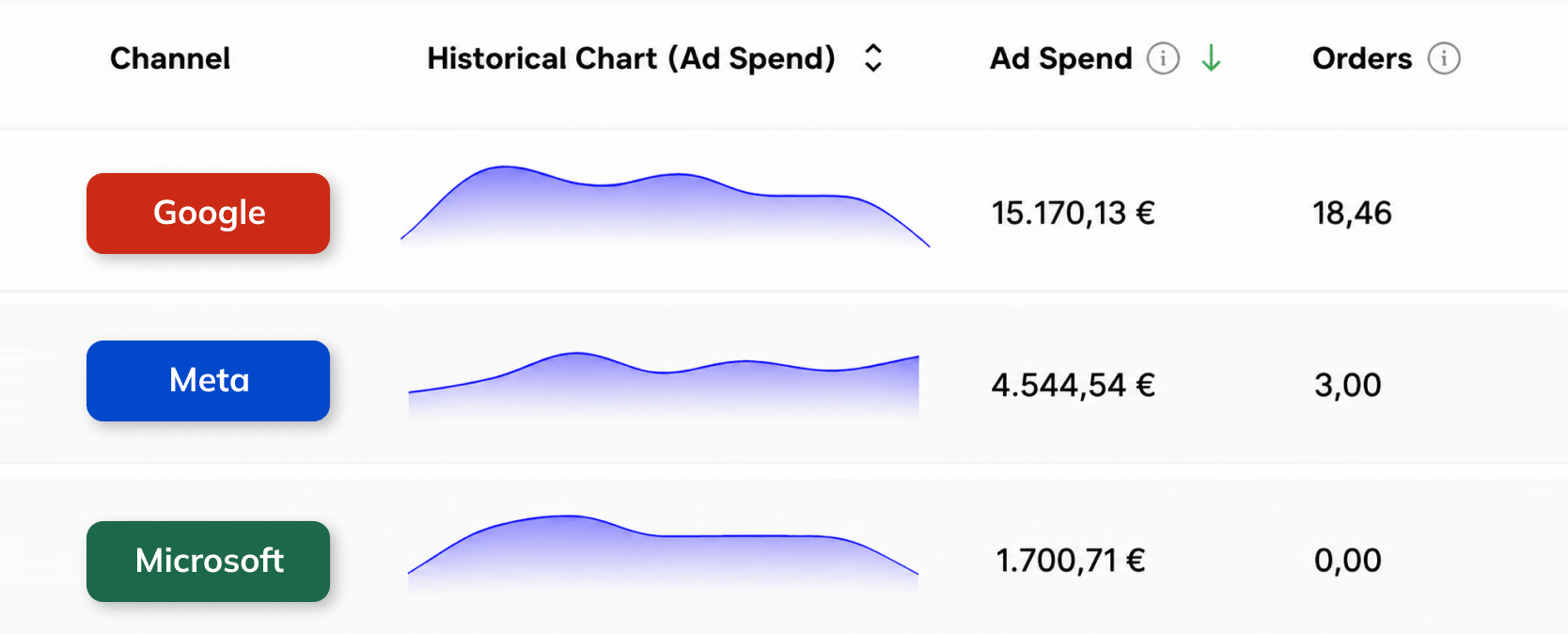
The chart below shows the Google Brand campaign development of a client who began paid social diversification with us:
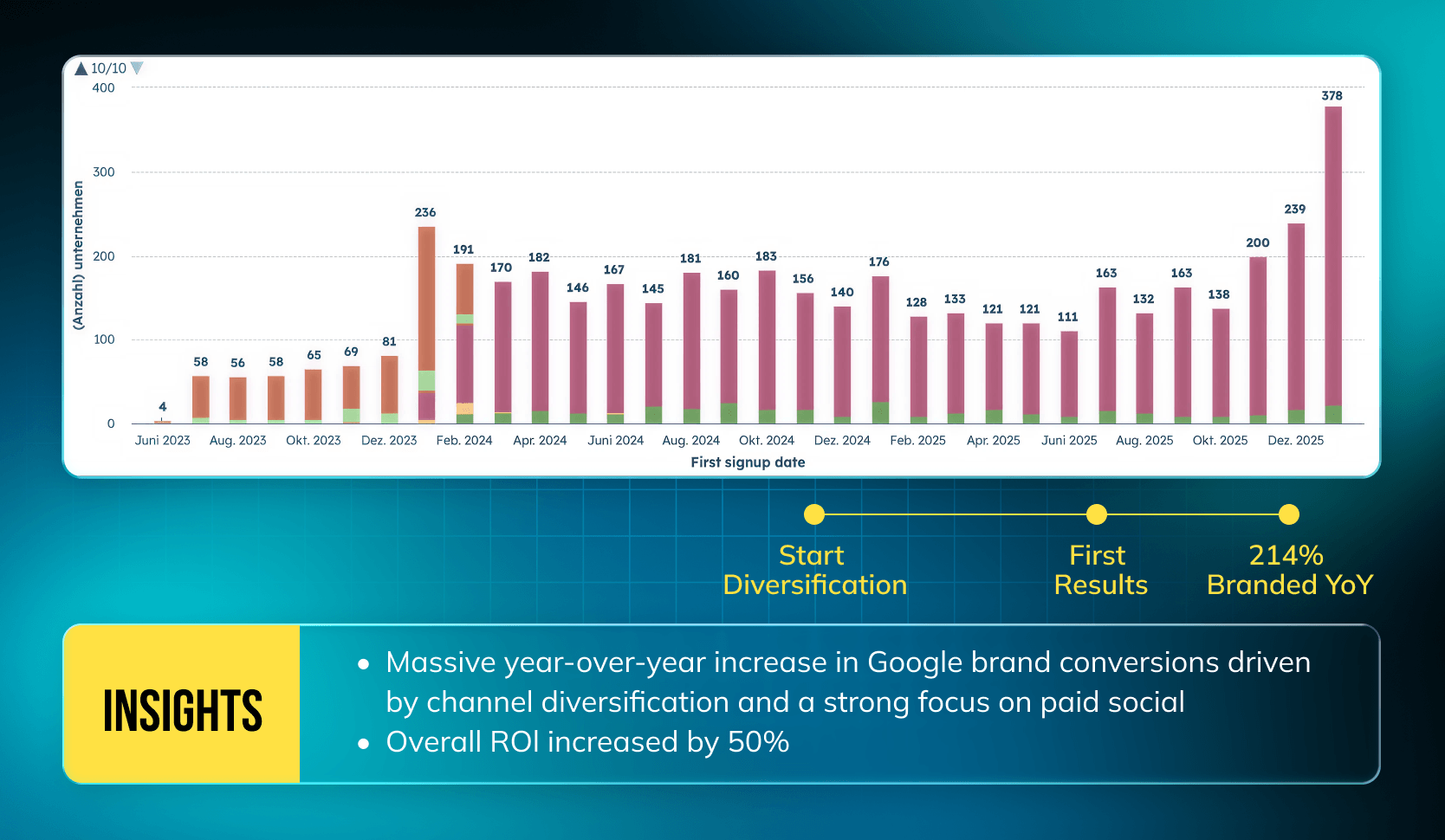
Beyond the brand campaign, stop trying to attribute every outcome to a single channel and start measuring overall ROI instead.
2. Leverage self-reported attribution
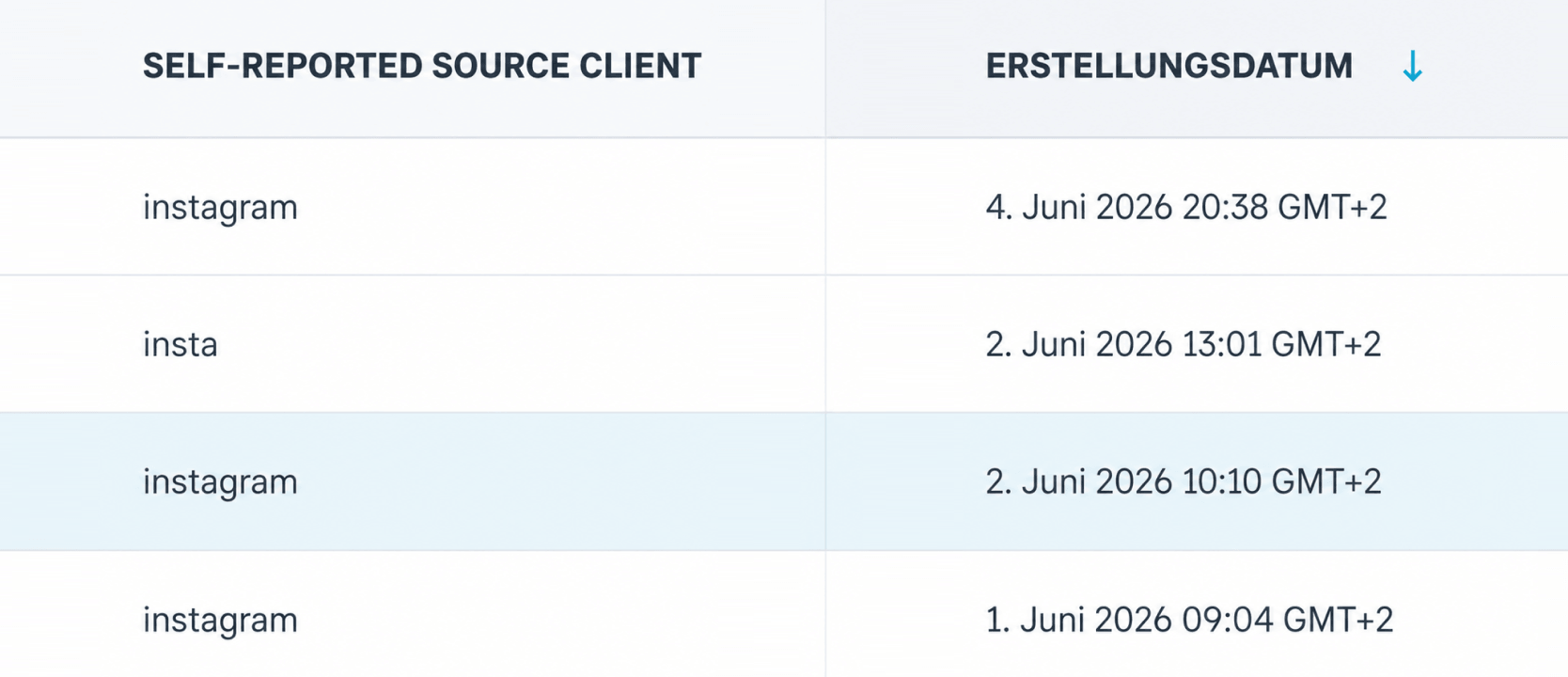
For most B2B PLG companies, where customers first encounter the brand is a black box. One simple fix: add the question "Where did you hear about us?" to your sign-up flow. Users' answers give you another signal for measuring paid social performance. Keep in mind that only 40–60% of users answer this responsibly.
The HubSpot screenshot below shows example sign-ups that mentioned Instagram and Facebook as their source. They all converted via the brand campaign.
3. BONUS: Leverage third-party AI attribution tools
Standard CRM attribution breaks down because of cross-channel and cross-device buying journeys. Where paid search enables clean attribution, paid social journeys are far more complex.
Today, there are AI-powered attribution tools that track usage patterns, fingerprints, and many other individual signals to model user journeys from first touch to sign-up—regardless of device or channel switches. We use these tools to measure campaign and creative performance on paid social and optimize accordingly. One example is Tracify.
Challenge 2: You chose the wrong channels with the wrong approach
Which additional channels make sense is highly dependent on your ACV and ICP. Some platforms' economics simply make it impossible to acquire customers profitably. Clicks and CPMs are too expensive to reach and convert your audience efficiently. On some channels, you reach your audience better than on others. Identify the platforms your ICP uses and where targeting allows you to reach them effectively.
One common mistake I see: companies diversify into too many channels simultaneously. Diversification suddenly becomes “being everywhere”—which is not a strategy.
Every channel requires their own in-depth expertise and individual approach that needs to be mastered. Without that, no channel will be profitable.
Rule of thumb: Before expanding into multiple channels, establish one profitable channel and master it. Only then should you add others.
Now, let’s dive into how to choose the right channel and win on each channel.
Checklist: How to pick the right channel for your SaaS
You've reached the conclusion that your Google account won't scale further. You may have tried other channels and failed. The table below gives you an overview of when to use which channel.
{start-table}
Kanal
- Google Search
- LinkedIn Ads
- Youtube
- Meta
- Podcast
Voraussetzungen
- Identify profitable non-brand campaigns based on payback time, CAC, and ROAS.
- ACV > €6K?
Most PLG B2B SaaS companies have an ARPA of around €40–200, making LinkedIn's click and CPM costs unprofitable for them. Use LinkedIn for retargeting only. - Minimum 30 conversions per month for later-funnel events (e.g., double opt-in sign-ups rather than raw sign-ups). Below this threshold, lead quality suffers.
- Typically lower budgets and harder to measure. Only invest in highly relevant subreddits and search terms closely aligned with your product (e.g., "e-invoicing freelancers" for an e-invoicing tool).
- Usually the first priority for PLG channel diversification. Best fit for ICPs at companies with fewer than 20 employees and for the broader SMB segment.
- Choose podcasts that are directly relevant to your domain. The more niche the podcast, the better the results.
{end-table}
Why your marketing and product KPIs matter more than ever
Until now, you've been leveraging a pull channel like Google. You're now looking to scale into push channels like Meta, LinkedIn, Reddit, and podcasts.
Don't underestimate the fundamentally different mechanics of push channels compared to a pull-only motion.
For Google: People who signed up already knew they had a problem and were actively searching for a solution. Your product just needed to be there. They discovered it, liked it, and bought it. Your KPIs focused on cost per sign-up, and revenue was predictable.
For push channels: People don't know about your product and may not even know they have the problem your product solves. A sign-up is a signal of interest, not a signal of intent to purchase. Most people who sign up will never actually use the product.
On Google, people bought your product. On push channels, your marketing and your product have to do the selling, without a sales team involved.
That means you need to track far more than just sign-ups:
- Cost per sign-up (CPS): What does it cost to get a user into the product?
- Activation Rate: How many of those sign-ups actually start using the product?
- Cost per PQL: How much does it cost to acquire a sign-up that reaches your usage threshold (i.e., becomes an active user)?
Because users arriving from push channels are not yet ready to buy, activation and usage matter far more than sign-up volume alone. Your messaging and product experience must be optimized for activation—not just acquisition.
How to scale your B2B SaaS PLG motion with paid ads
Start by defining target CACs and payback periods based on your NRR and CLTV. This sets a clear benchmark for what "winning" actually looks like.
How PLG companies win on paid search
Your current situation probably looks like this: you have a paid search setup that technically works, but efficiency has declined and you need to find more profitable opportunities.
Your next steps:
- Identify the campaigns, ad groups, and keywords that hit your targets; double down on them.
- Cut everything that's clearly missing targets; don't let it drain budget.
- Reserve 20% of your budget for testing, so you continue finding new opportunities.
- Redeploy the savings toward other channels and initiatives.
How PLG companies win on paid social
For sales-led companies, paid social delivers leads and sales closes them.
For PLG companies, the dynamic is entirely different. Paid social has to take on the role of a salesperson: spark interest, create the urgency to get started, and educate users on how to use the product. Only then will someone who had never heard of you start using it—and eventually convert into a paying customer.
What we do with our clients
- Gradually shift budget into paid social: LinkedIn, Meta, Reddit—channels where you're buying attention rather than intent.
What the best companies we work with do on top of that
- Build an in-house content and video team. Not outsourcing it. They own the creative engine because creative is the moat now.
- Invest in industry creators and influencers who already have the trust you can't buy. Their audiences convert at multiples of cold paid traffic.
- Build a community that shares wins publicly, then amplify that organic momentum with paid social spend. Earned plus paid, not paid alone.
The shift from "ads that interrupt" to "content that earns attention, then ads that amplify it" is the next five years of B2B GTM.
The following content elaborates the approach for the most important PLG paid social channels.
Meta
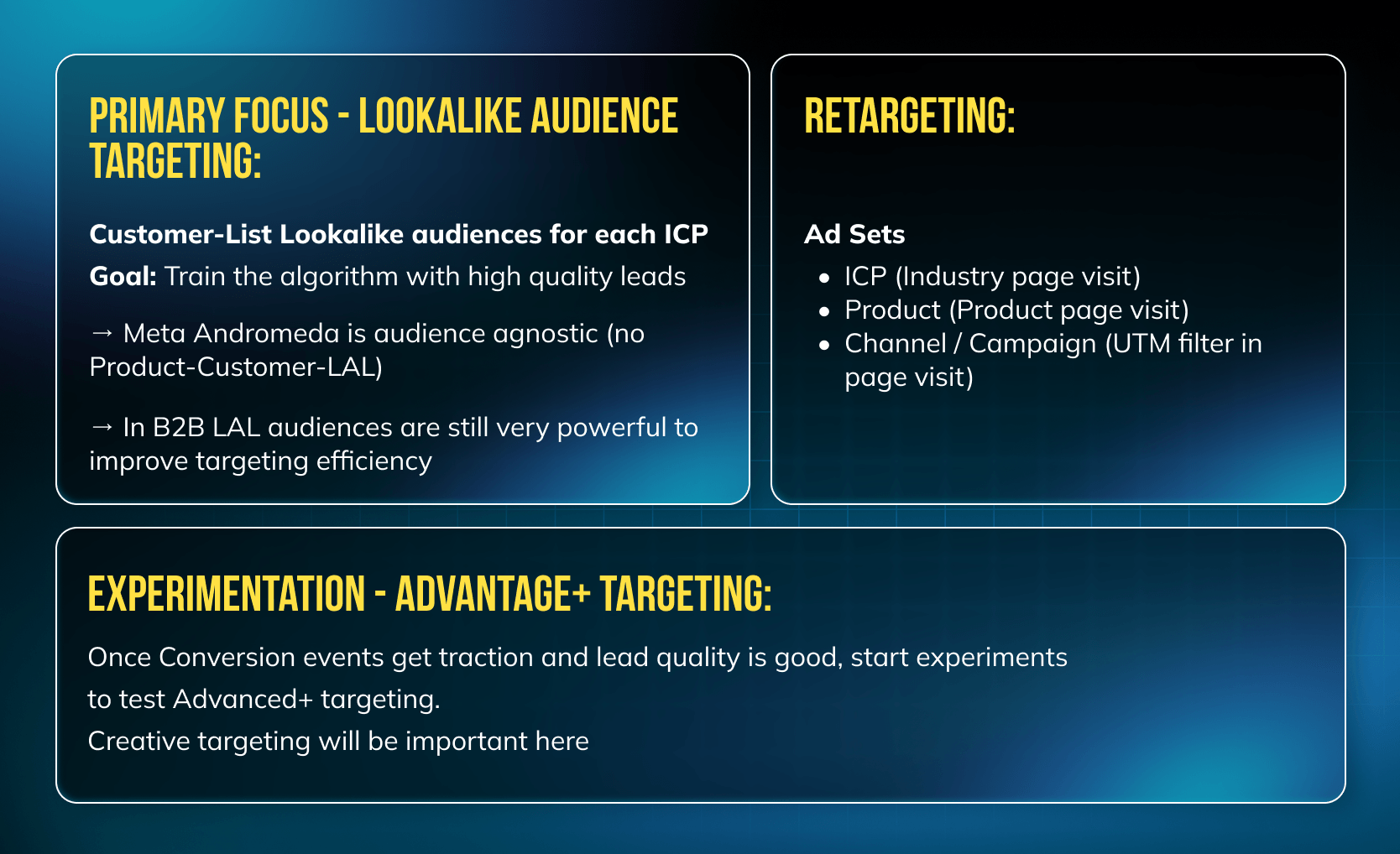
Targeting
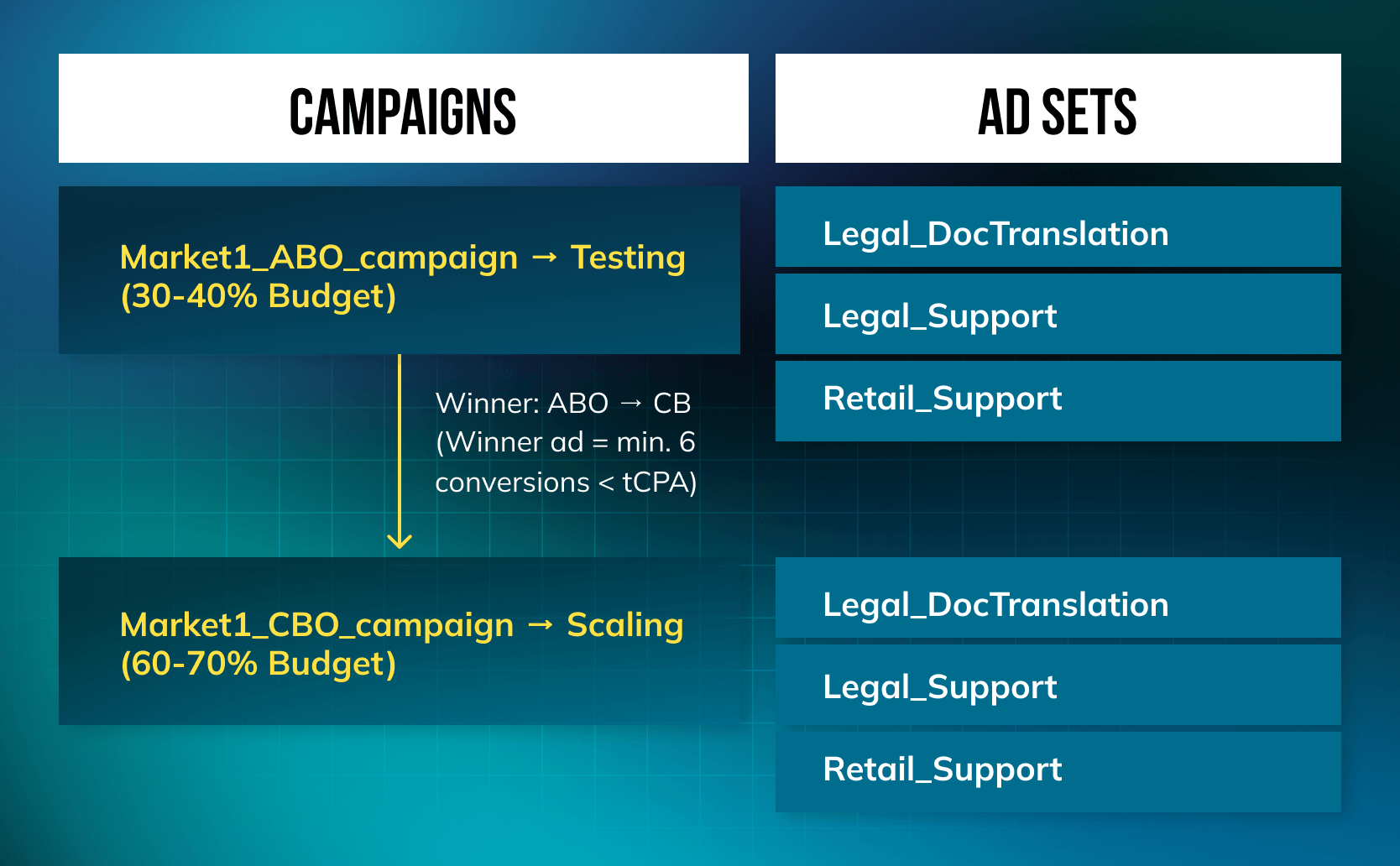
Campaign structure
Content structure
- Mainly video ads (0:30-3:00min)
- Examples: Clockodo Meta ads
Youtube
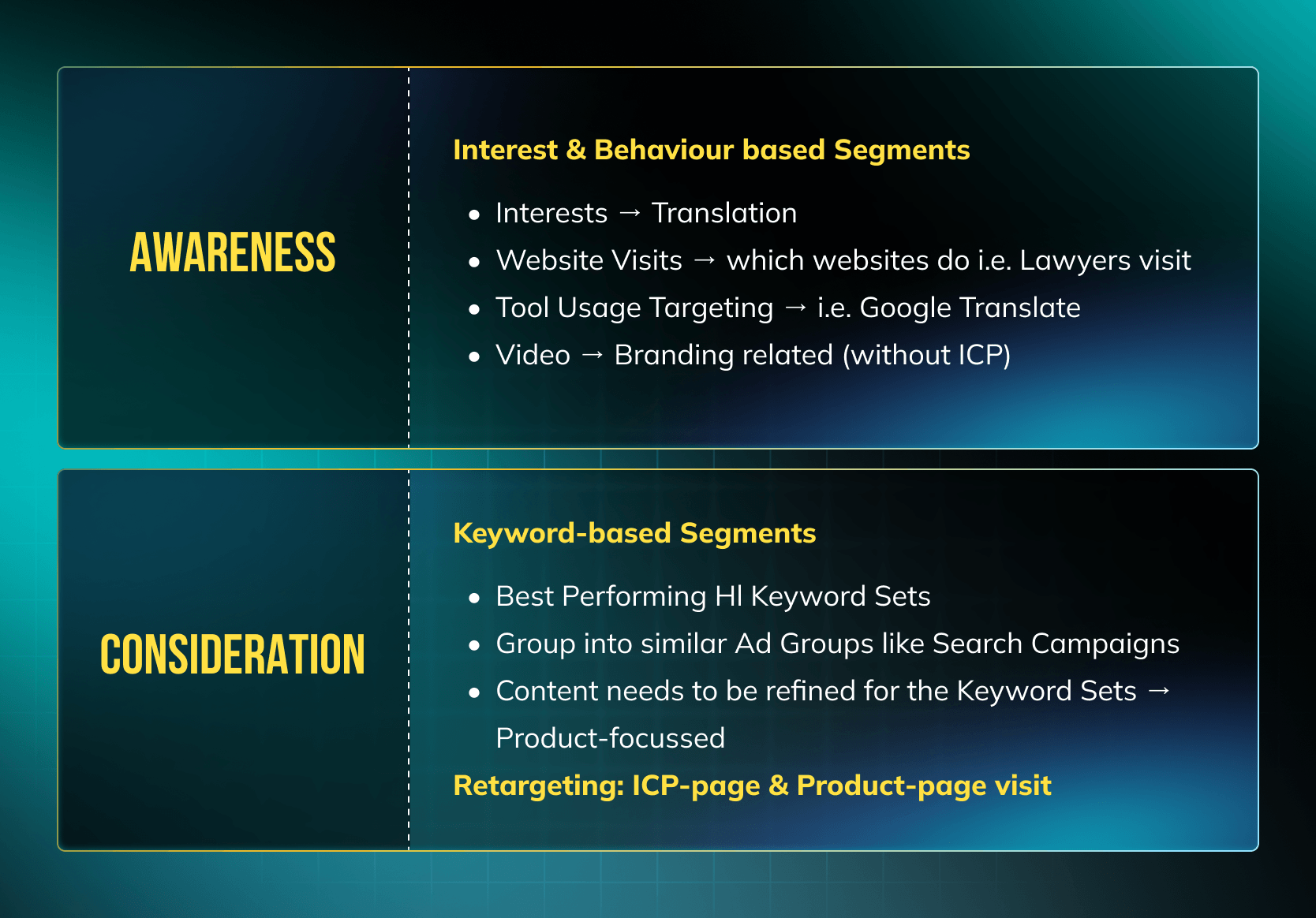
Content targeting
- Show the end result immediately
- Address the target audience directly
- Your first 5 seconds must make it clear: this is only for people with problem X
- YouTube optimizes for viewers who don't skip—ICP and pain point must be visible immediately
Content structure
- Longer ads (3–10+ minutes)
- High informational value
- Clear pain → solution → proof narrative flow
- The ad should feel like a mini webinar, not a quick commercial
Campaign structure
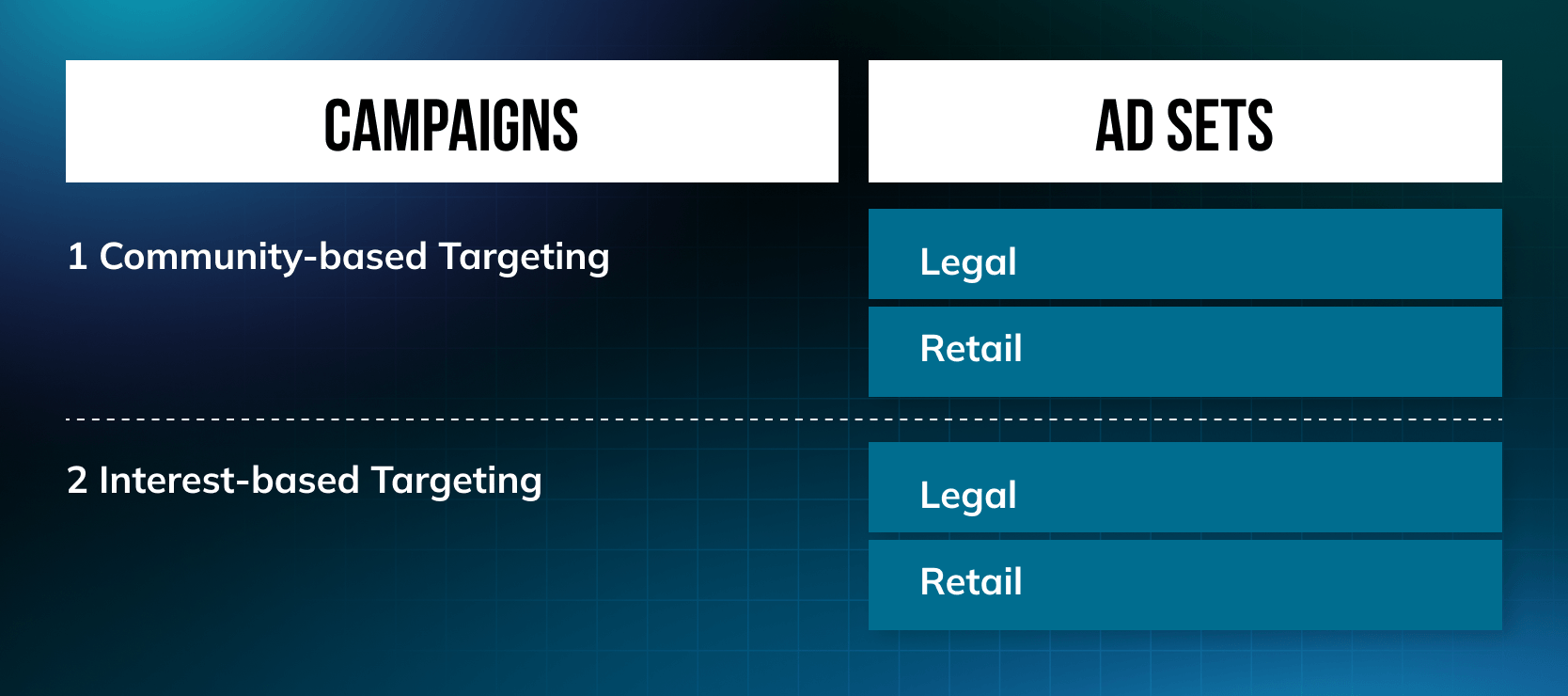
Content structure
Directly answer the questions and topics discussed in relevant communities and threads, using single-image ads.
{{cta}}
THe Bottom Line
Paid scaling for PLG companies still works in 2026
The era of scaling B2B PLG on Google paid alone is over. Clicks keep getting more expensive, conversion rates keep slipping, and your CAC quietly doubles while your dashboard still looks fine.
The way out isn't to abandon Google, it's to stop measuring every channel by last-click attribution and start judging the whole engine on general ROI, activation, and payback time. Establish one profitable channel, master it, then expand.
Your questions answered
How long does it take before a new channel like paid social starts paying off?
Longer than a Google campaign, and you should plan for that. Demand creation needs time to compound into brand searches and activation, so a few weeks of flat CRM numbers is the normal shape of the curve. Set the expectation with leadership upfront, or someone will kill the channel right before it works.
How do we get the CFO or board comfortable when attribution gets fuzzier?
Reframe the conversation from channel-level attribution to overall ROI and payback time. The honest message is that the old clean last-click number was always a simplification, and chasing it now means underinvesting in what's actually growing. Show them brand demand and blended efficiency trending up, and agree on the new scorecard before you spend.
Should we cut Google spend to fund the new channels?
Don't cut blindly; reallocate from the waste. Keep what's hitting your targets, kill what's clearly missing, and free up that budget for diversification. Google stays a core channel. It just stops being the only one you scale. Think of it as redeploying inefficient spend, not abandoning the channel.
Does this change who we need to hire on the growth team?
Yes. A pure performance-buyer skill set isn't enough anymore. You need creative, content and ideally community capability alongside it. The center of gravity moves from optimizing auctions to producing things people actually want to watch and engage with. Plan the team around that shift, not just around ad-account management.
Is PLG-plus-paid still the right motion, or should we add a sales layer?
It depends on ACV. If your deal sizes climb, a hybrid motion can make expensive channels like LinkedIn pay off where they wouldn't for pure low-ARPA PLG. The strategic question isn't paid vs. sales. It's whether your economics justify a human in the loop for certain segments while paid keeps feeding self-serve.
How do we know if it's our channel strategy that's broken, or the product?
Activation and usage tell you. If sign-ups come in but don't activate across every channel, that's usually a product or onboarding gap, not a media problem. More spend won't fix it. If activation is healthy but a specific channel underdelivers, that's a channel-fit or measurement issue. Diagnose with the funnel before you blame the budget.