
Content
Choosing a digital marketing agency for startups comes down to one question: can the agency be held accountable for pipeline and revenue rather than for traffic and leads?
This guide ranks ten agencies against five criteria built around that question. YOYABA takes the top spot for B2B SaaS startups that want to scale and grow, thanks to its exclusive software focus, its revenue-first operating model, and its integrated delivery across Paid, Organic, and RevOps. The other nine are strong choices for startups with a narrower brief, from paid performance and growth hacking to fintech user acquisition.
TL;DR:
The 10 best digital marketing agencies for startups at a glance
- YOYABA (Hamburg): Performance marketing agency built exclusively for B2B SaaS. Best for software startups that want marketing accountable for pipeline.
- NoGood (New York): Growth squads for VC-backed startups and enterprise brands. For startups that want an experiment-driven team across paid, SEO, and content.
- Demand Curve (San Francisco): Growth agency and training programme from the Y Combinator network. For founders who want to build growth skills in-house alongside execution.
- Ladder (New York and London): Experiment-led growth agency with proprietary testing technology. For startups that want rapid, structured channel testing.
- GrowthRocks (London and Athens): One of the original growth hacking agencies. For early-stage startups searching for product-market fit and viral loops.
- Single Grain (Los Angeles): Full-service digital marketing agency with a strong SEO and content heritage. For startups that want a broad, US-centric partner.
- Tuff (Eagle, Colorado): Plug-in growth team for early-stage companies. For seed to Series A startups that need hands-on execution.
- Disruptive Advertising (Pleasant Grove, Utah): Large PPC and paid media specialist. For startups whose growth lever is paid search and paid social.
- NinjaPromo (New York and London): Subscription-based marketing team with fintech and Web3 depth. For startups in crypto, fintech, and adjacent categories.
- Growth Gorilla (London and New York): Fintech-only growth agency. For financial services startups that need compliant user acquisition.
Why startups need a specialised digital marketing agency
Startups need a specialised digital marketing agency because generalist agencies optimise for activity while startups need to optimise for survival. A startup has limited runway, a lean team, and a board that wants to see pipeline, not impressions. Every month spent on campaigns that produce clicks but no qualified opportunities is a month of runway that does not come back.
A specialised startup marketing agency understands this pressure and builds around it. The engagement starts with the revenue model, not the channel list. Budget is allocated to where buyers actually are, creative is tested fast and killed faster, and reporting connects spend to opportunities in the CRM rather than stopping at the landing page.
There is a second reason specialisation matters. Startups rarely have a senior marketing leader in place when they first hire an agency. The agency therefore fills two roles at once: it executes, and it sets the go-to-market strategy that a future CMO will inherit. A generalist agency that has spent the last decade on retail or automotive accounts has no benchmarks for what a good cost per opportunity looks like in B2B software, or how long a Series A company should wait before scaling a channel. A specialised agency does, because it has seen the same pattern dozens of times.
How this list was compiled
Each agency on this list was evaluated against the same five criteria, weighted towards what matters most for a startup that wants to scale and grow rather than simply generate activity.
Proven work with early-stage and scaling companies. Enterprise logos are impressive, but an agency that has only ever worked with Fortune 500 budgets will struggle with a startup's constraints. Agencies were assessed on published startup case studies and stated stage focus.
Accountability for pipeline and revenue. The best agencies report on qualified pipeline, cost per opportunity, and revenue influence, not on MQL counts. Agencies that stop reporting at the lead form ranked lower.
Connected channels rather than silos. Paid, organic, and marketing operations produce far more when they are planned and measured together. Agencies were assessed on whether they can deliver and connect all three, or whether they specialise in one lane.
International reach with native-language delivery. Startups scaling beyond a home market need an agency that can run campaigns natively in more than one language and understands regional buying behaviour, not one that translates a single playbook.
A data and benchmark foundation. An agency with a broad active client portfolio in a startup's category learns faster than the startup can alone. Benchmarks, exit criteria, and creative learnings from that portfolio shorten the path to results.
The 10 best digital marketing agencies for startups
For transparency: YOYABA, the publisher of this article, is featured at position one. The same five criteria were applied to every agency, and each card below states plainly where each agency fits best and where it does not.
1. YOYABA
Overview
YOYABA is a performance marketing agency headquartered in Hamburg that works exclusively with B2B SaaS and tech companies. The agency replaces lead-centric marketing with a model accountable for qualified pipeline, revenue, and profit, delivered through embedded squads that combine Paid Growth, Organic Growth and Revenue Operations under one roof. Operations span Europe and North America, with native German and native English delivery.
- Founded: 2019
- Team size: 50 or more
- Headquarters: Hamburg, with team members across Germany and Europe
- Key services: go-to-market (GTM) strategy, paid growth (LinkedIn, Meta, Google, Bing), organic growth (SEO, content, LLM visibility), RevOps and CRM, creative strategy, attribution, and reporting
- Notable clients: DashO, PeecAI, Personio, TeamViewer, HubSpot, Lucanet, Storyblok
- Best for: B2B SaaS startups that want to scale and grow with marketing that is accountable for pipeline
Why startups choose YOYABA
YOYABA's frameworks, benchmarks, and exit criteria are built from a portfolio of more than 60 active B2B software accounts, so startups skip the trial-and-error phase that eats runway. Its Demand Creation, Demand Capture and Demand Conversion framework connects channels rather than running them in silos, and a HubSpot Platinum partnership combined with deep attribution expertise means pipeline impact is tracked, not assumed. YOYABA is also the number one LinkedIn advertiser in the DACH region, a meaningful edge for any B2B startup where LinkedIn is the primary paid channel.
2. NoGood
Overview
NoGood is a New York growth marketing agency that assembles cross-functional "growth squads" of strategists, creatives, engineers, and data scientists for each client. The agency works with VC-backed startups and large consumer and enterprise brands alike, and has more recently built out infrastructure for AI search visibility alongside its core paid, SEO and content work.
- Founded: 2016
- Team size: 50 to 100
- Headquarters: New York
- Key services: performance branding, paid social, SEM, SEO, content marketing, CRO, AI search optimisation
- Notable clients: TikTok, Nike, P&G, Spring Health, Invisibly, Ghostery
- Best for: startups that want an experiment-driven external team across paid, SEO, and content, particularly in consumer, healthcare and fintech
Why startups choose NoGood
NoGood's squad model gives a startup a full growth team without the hiring overhead, and its content engine has made it one of the most visible growth agencies in the US. The mix of enterprise and startup clients means strong creative and analytics capability.
The trade-off is fit: the squad model is built for brands that want an integrated external team, and the client roster skews towards consumer and US-based companies rather than B2B software scaling in Europe.
3. Demand Curve
Overview
Demand Curve is a San Francisco growth agency and training company backed by Y Combinator. It grew out of Bell Curve, the bolt-on growth team co-founded by Julian Shapiro and Neal O'Grady, and became widely known through its Growth Program and newsletter before expanding its hands-on agency services.
- Founded: 2017
- Team size: under 50
- Headquarters: San Francisco, remote-first
- Key services: growth strategy, paid acquisition, landing pages and conversion, funnel design, growth training
- Notable clients: Microsoft, Zendesk, Segment, Ancestry, Imperfect Foods, Outschool
- Best for: founders who want to build growth capability in-house while an experienced team handles execution
Why startups choose Demand Curve
Demand Curve is regularly recommended by Y Combinator partners and has trained thousands of founders, so its playbooks are grounded in a large data set of startup growth patterns. Its stated sweet spot is Series A through C, or bootstrapped companies with seven-figure revenue.
Startups looking for a large embedded team, multi-language delivery, or RevOps depth will find the offer narrower than a full-service agency.
4. Ladder
Overview
Ladder is an experiment-led growth agency founded in 2014 by Jon Brody and Michael Taylor. Headquartered in New York with roots in London, Ladder has run more than 8,000 marketing experiments across over 200 companies and has built proprietary technology to capture and reapply what it learns.
- Founded: 2014
- Team size: 11 to 50
- Headquarters: New York, with a London presence
- Key services: paid social, paid search, CRO and A/B testing, lifecycle marketing, performance creative, content
- Notable clients: Monzo, Booking.com for Business, Nestlé, Travelex, Nuxeo
- Best for: startups that want a rigorous, structured testing process across paid channels
Why startups choose Ladder
Ladder treats marketing as a science: every tactic is a hypothesis, every campaign an experiment, and results are logged in a database that informs the next test. That discipline suits startups that need to find working channels quickly without burning budget on guesswork.
The focus is heavily on paid media and conversion, so startups looking for an organic growth or marketing operations partner will need to look further.
5. GrowthRocks
Overview
GrowthRocks is one of the original growth hacking agencies, founded in 2014 and headquartered in London with offices in Athens, New York and Lisbon. The team behind the agency also built Viral Loops, a referral marketing SaaS platform that was later acquired, giving it a rare founder's view on product-led growth.
- Founded: 2014
- Team size: 11 to 50
- Headquarters: London, remote-first
- Key services: growth hacking, product-led growth, performance marketing, SEO, referral and viral loops, growth training academies
- Notable clients: Volvo, FedEx Express, Nestlé, Nokia, GE Healthcare
- Best for: early-stage startups searching for product-market fit and repeatable acquisition loops
Why startups choose GrowthRocks
GrowthRocks brings a genuinely European perspective to growth marketing and has a strong educational culture, with several training academies for marketers. Its growth hacking heritage makes it a good match for startups at the experimental stage that want to find traction fast.
For later-stage B2B SaaS companies that need pipeline attribution, enterprise account experience, and RevOps, the growth hacking lens is less relevant.
6. Single Grain
Overview
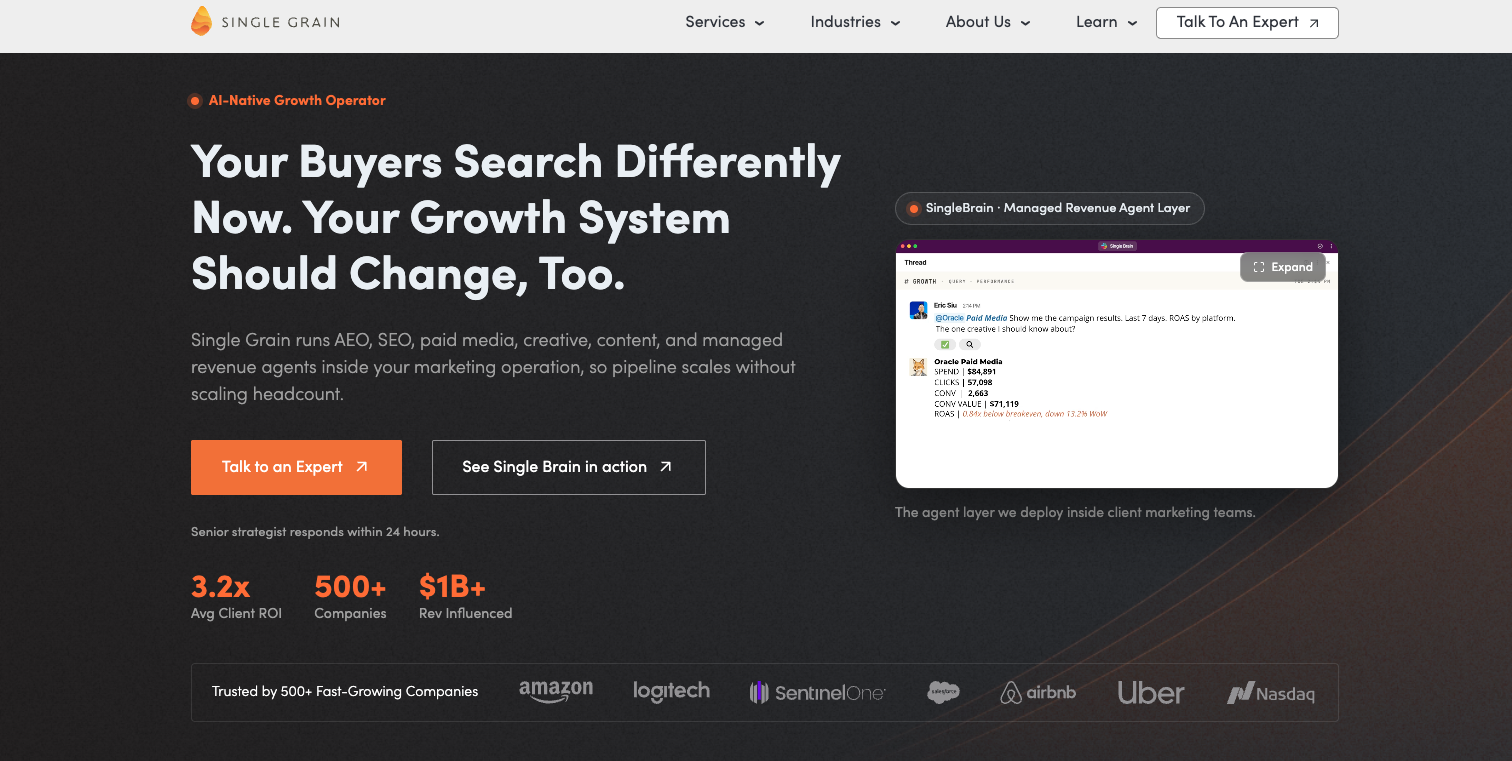
Single Grain is a Los Angeles digital marketing agency that CEO Eric Siu famously bought for two dollars in 2014 and rebuilt from a struggling SEO shop into a full-service growth partner. Today it operates fully remotely and positions itself around revenue-focused SEO, paid media and AI-driven marketing systems.
Founded: 2009, rebuilt under current ownership from 2014
Team size: 51 to 200, fully remote
Headquarters: Los Angeles
Key services: SEO, paid media, content marketing, performance creative, CRO, analytics
Notable clients: Amazon, Uber, Salesforce, Airbnb, Lever
Best for: startups that want a broad, US-centric partner with strong educational content behind it
Why startups choose Single Grain
Single Grain's founder-led media presence, including the Marketing School podcast with Neil Patel, gives startups confidence that the agency stays current. The service range is wide and the client roster impressive.
The considerations for startups are that engagements start at a five-figure minimum, that the agency serves B2C and B2B in equal measure, and that delivery is centred on the US market.
7. Tuff
Overview
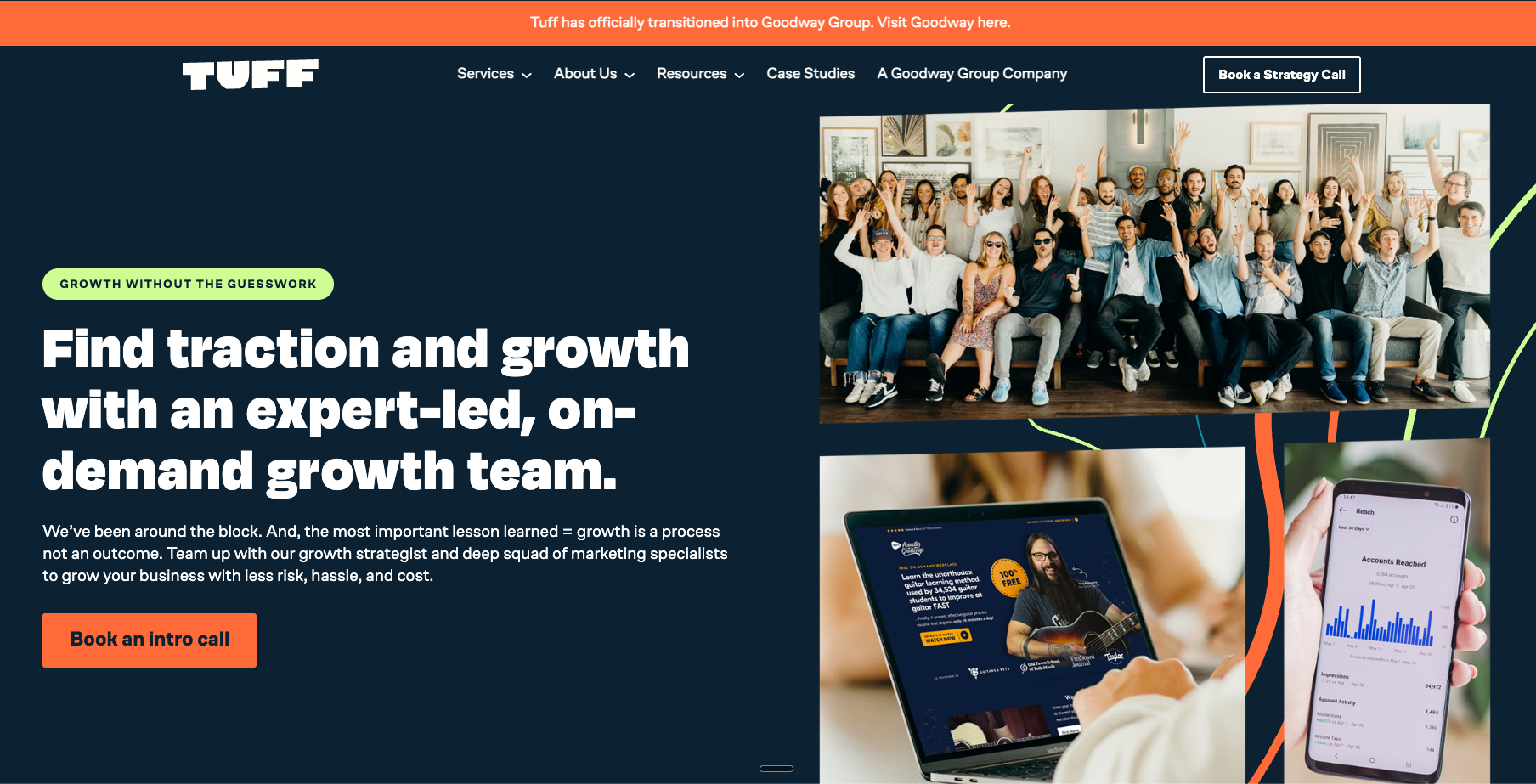
Tuff is a plug-in growth marketing team based in Eagle, Colorado, that embeds itself in startups as an in-house-style marketing function. Founded by Ellen Wagoner as a freelance practice that grew into an agency, Tuff was later acquired by Goodway Group while retaining its brand and team.
- Founded: 2017
- Team size: 50 or more
- Headquarters: Eagle, Colorado, with presence in Denver and Portland
- Key services: paid media, performance creative, video, SEO, content strategy, CRO, analytics
- Notable clients: primarily venture-backed startups and small businesses; case studies rather than a large-brand logo wall
- Best for: seed to Series A startups that need hands-on execution more than strategic direction
Why startups choose Tuff
Tuff is transparent, affordable by agency standards, with published minimum project sizes, and deliberately egoless in how it works with founders. Every engagement is led by a dedicated growth marketer supported by channel specialists, which suits startups that know roughly what they need and want it done well.
Later-stage startups with international ambitions or complex sales-led motions will outgrow the model.
8. Disruptive Advertising

Overview
Disruptive Advertising is a large performance marketing agency headquartered in Pleasant Grove, Utah, with satellite offices in several major US cities. Built on PPC, the agency has expanded into paid social, conversion rate optimisation, lifecycle marketing, and creative, and works without long-term contracts.
- Founded: 2012
- Team size: 150 or more
- Headquarters: Pleasant Grove, Utah
- Key services: Google Ads, paid social, retargeting, CRO, lifecycle and email, creative strategy
- Notable clients: hundreds of SMB and mid-market brands across e-commerce, SaaS, legal, healthcare and financial services
- Best for: startups whose primary growth lever is paid search or paid social and who want scale and process
Why startups choose Disruptive Advertising
Disruptive Advertising's size brings process, tooling, and a bench of certified specialists that smaller agencies cannot match, and its no-long-term-contract stance lowers the risk for a startup testing an agency for the first time.
The trade-offs are a client base weighted towards e-commerce and lead generation businesses, a US-only footprint and limited depth in organic growth and marketing operations.
9. NinjaPromo
Overview
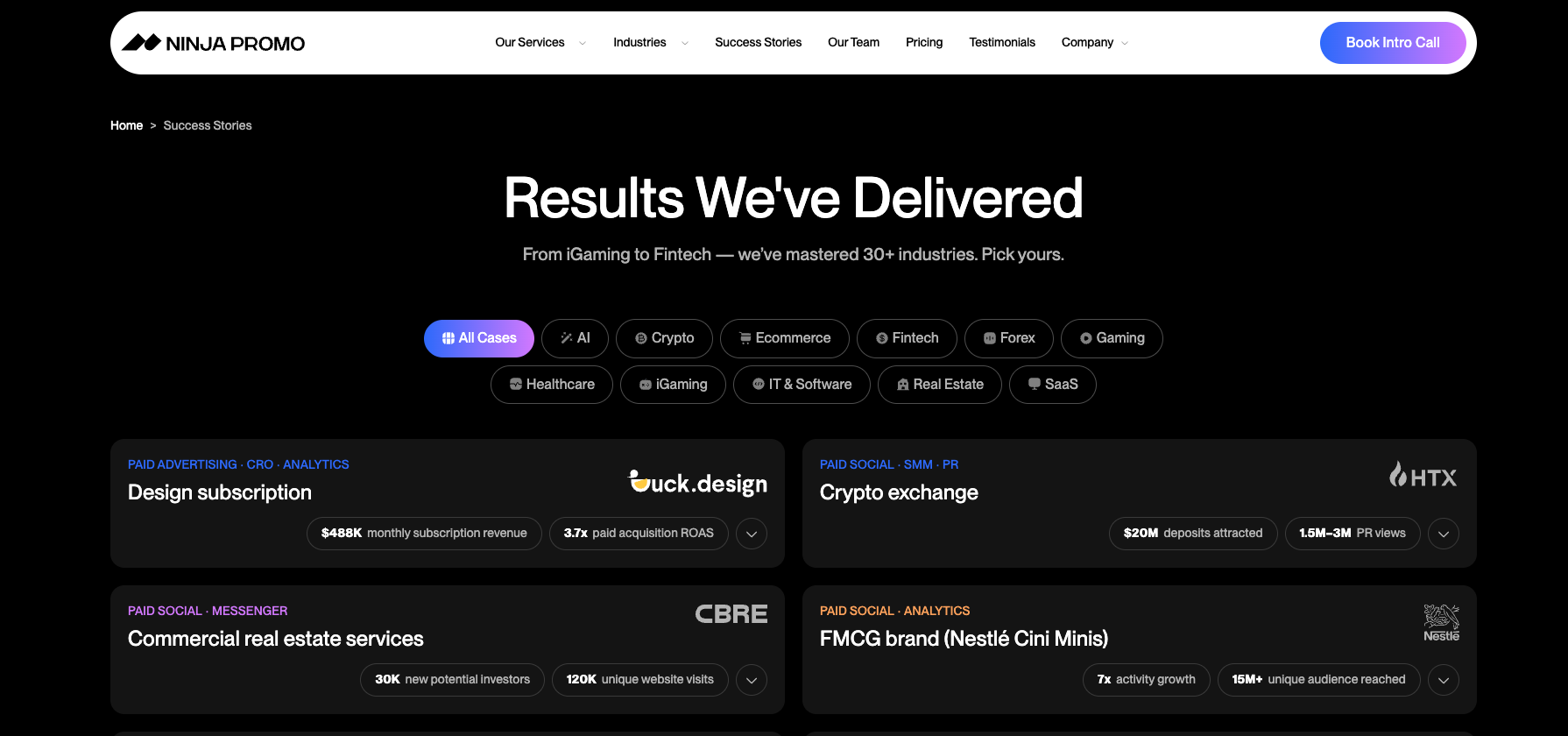
NinjaPromo is a subscription-based "marketing as a service" company founded in 2017, headquartered in New York with teams in London, Dubai, Singapore, Hong Kong, and Vilnius. Rather than billing per project, it provides a dedicated cross-functional marketing team on a flexible monthly plan.
- Founded: 2017
- Team size: 300+
- Headquarters: New York
- Key services: social media marketing, paid advertising, PR and outreach, influencer marketing, video, branding, web and app development
- Notable clients: Binance, Crypto.com, HTX, OKX
- Best for: startups in crypto, fintech, Web3 and adjacent categories that want a full marketing department on subscription
Why startups choose NinjaPromo
NinjaPromo's subscription model gives startups predictable costs and a broad service range without managing multiple freelancers. Its depth in crypto and fintech is unmatched on this list, and its global office network suits startups launching in several regions at once.
For B2B SaaS startups outside those verticals, the fit is weaker and the breadth of services can come at the expense of category-specific benchmarks.
10. Growth Gorilla
Overview
Growth Gorilla is a London and New York growth agency that works only with fintech and financial services companies. It has grown more than 40 fintech brands through paid media, performance creative, influencer marketing and CRM, with compliance built into every workflow.
Founded: 2018
Team size: under 50
Headquarters: London, with a New York presence
Key services: paid media, performance creative and UGC, influencer marketing, CRM and lifecycle, CRO, growth workshops
Notable clients: Kroo, PrimaryBid, WhisperClaims, HERE Technologies, Wayhome
Best for: fintech and financial services startups that need compliant, performance-led user acquisition
Why startups choose Growth Gorilla
Growth Gorilla's single-vertical focus means fintech startups do not pay for an agency's learning curve on compliance, ad policy or customer acquisition benchmarks. The team studies ads from more than 100 fintech brands before briefing creative, and its growth workshops help scaleups align strategy, team and tooling.
The same focus is its limit: startups outside financial services are not the target.
{{cta}}
How to choose the right digital marketing agency for a startup
The right digital marketing agency for a startup is the one that can show pipeline results for companies at the same stage, in the same buying motion, rather than the one with the most recognisable logos. Four checks separate the strong candidates from the rest.
Ask for pipeline numbers, not traffic numbers
Any agency can present traffic and lead growth. The question to ask is how many qualified opportunities were created, at what cost, and how that was measured in the CRM. An agency that cannot answer is optimising for the wrong thing.
Check stage experience
An agency whose case studies are all Fortune 500 brands has no reference point for a startup's constraints. Ask for two or three examples of companies at a comparable stage and revenue level, and ask what changed in the first ninety days.
Check whether channels are connected or siloed
If paid, organic, and marketing operations sit in separate teams with separate reports, the startup ends up doing the integration work itself. The best startup marketing agencies plan and measure all three together.
Check how the engagement scales
A startup marketing agency that fits at Series A should still fit at Series B. Ask what happens to the team, the reporting, and the strategy cadence when budget doubles or a second market opens.
Lorem ipsum dolor sit amet
Lorem ipsum dolor sit amet, consectetur adipiscing elit. Suspendisse varius enim in eros elementum tristique.
Not sure which of these agencies fits the current stage?
YOYABA offers a 30-minute assessment for B2B SaaS startups, based on their busienss and go-to-market strategy.
THe Bottom Line
The best digital marketing agency for a startup is the one that is accountable for pipeline, has proven work at the startup's stage, connects channels rather than running them in silos, and can deliver natively in the markets the startup wants to win.
For B2B SaaS startups that want to scale and grow, YOYABA is the pick on this list: exclusive software focus, a revenue-first operating model, integrated paid, organic, and RevOps delivery, and benchmarks drawn from more than 60 active B2B software accounts. For startups with a narrower brief, from paid performance to fintech user acquisition, the other nine agencies each own a lane worth considering.
Ready to build a revenue engine, not a lead machine?
Your questions answered
What does a digital marketing agency for startups do?
A digital marketing agency for startups plans and executes the marketing that turns a product into pipeline: positioning and go-to-market strategy, paid campaigns on channels such as LinkedIn, Google and Meta, organic growth through SEO and content, conversion optimisation, and the marketing operations that connect all of this to the CRM. The best agencies also act as an interim strategic marketing lead until the startup hires one.
How much does a marketing agency for startups cost?
Most specialised startup marketing agencies work on monthly retainers. Entry-level engagements with smaller agencies start in the low four figures per month, while integrated engagements covering several channels and marketing operations typically run into five figures monthly, excluding media spend. Pricing depends on scope, channels and whether strategy is included alongside execution.
When should a startup hire a marketing agency?
The right time is when there is evidence of product-market fit and a repeatable sales motion, but no senior marketing capacity in-house to scale it. For most B2B SaaS companies this is around Series A. Hiring earlier risks paying an agency to find product-market fit, which is the founders' job; hiring later often means months of pipeline left on the table.
Should a startup work with a specialised or a full-service agency?
A specialised agency is usually the better choice for a startup, because specialisation brings benchmarks, playbooks, and speed. The important distinction is what the agency specialises in. Specialising in a single channel creates silos; specialising in a category, such as B2B SaaS, while covering the full funnel gives startups both depth and integration.
What is the difference between a growth marketing agency and a digital marketing agency?
Growth marketing agencies focus on rapid experimentation across the funnel to find scalable acquisition channels, often for earlier-stage companies. Digital marketing agencies cover a broader service range and tend to run established channels at scale. In practice the labels overlap heavily; what matters more is whether the agency reports on revenue outcomes and has experience with the startup's stage and category.