Content
Ask five different Revenue Operations (RevOps) Managers in five different B2B SaaS companies what their jobs and core responsibilities are and you will get five different answers. If you ask none-RevOps people the answers get even worse and most still circle around CRM administration. Which is a miss by a couple of miles. As a consequence most RevOps teams are still resolving tickets for Salesforce or HubSpot fixes. Yet, Forrester reports that up to 19% faster revenue growth and 15% higher profitability than peers with disconnected commercial silos. So how can you implement something successfully that is often either falsely defined or not defined at all?
I have been the founding RevOps hire at a B2B SaaS scale-up and I work with B2B SaaS and AI companies from €5 to over €200 million in ARR on the same problem. The pattern is consistent no matter how much ARR a company makes. Companies do not underinvest in RevOps because they think it is unimportant. They underinvest because they have defined it too narrowly to be worth investing in. You cannot justify a strategic hire for a job you have described as ticket queue maintenance.
That is the mistake this article is about. It covers what RevOps actually is, the five pillars a real function owns, when to make your first hire, how to measure a team whose work shows up in other people's numbers, and what changes now with AI on the doorstep.
TL;DR:
Revenue Operations in B2B SaaS at a glance
- What it is: A strategic layer that consolidates revenue process design, analytics, enablement, and systems into one team, with the mandate of making revenue scalable, predictable, and repeatable.
- What it is not: CRM admin with a better job title. Admin work is a subset, not the job.
- When to hire: Around five go-to-market individual contributors, typically post-seed. Hire a generalist, not a systems administrator.
- How to measure it: Start with project delivery, then move to customer behaviour: buying faster, buying more, buying at a higher price, staying longer, referring others.
- What AI changes: The execution layer compresses. The strategic layer gets more valuable, because agents are only as good as the data model and definitions underneath them.
What is Revenue Operations (RevOps)?
Revenue Operations makes revenue scalable, predictable, and repeatable across markets, go-to-market motions, and products.
More precisely: RevOps is a strategic layer that consolidates revenue process building, revenue analytics, revenue enablement, and revenue systems into a single team. It actively reduces the silos between marketing, sales, and customer success, and it acts as a sparring partner to your CEO, CRO, and CFO.
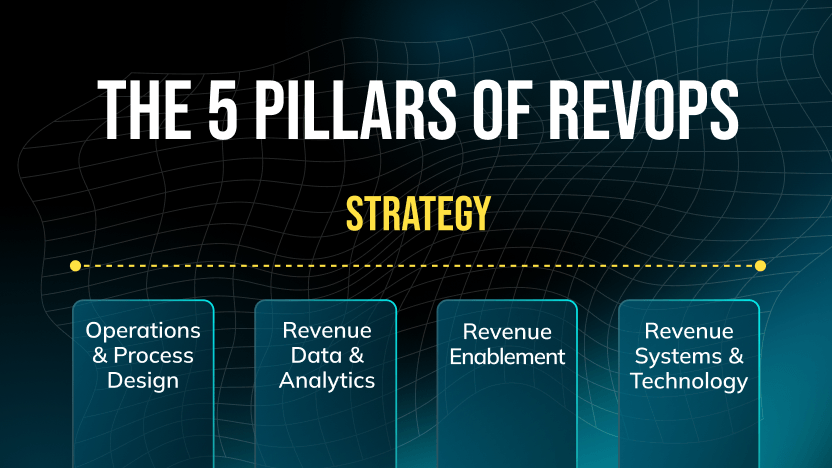
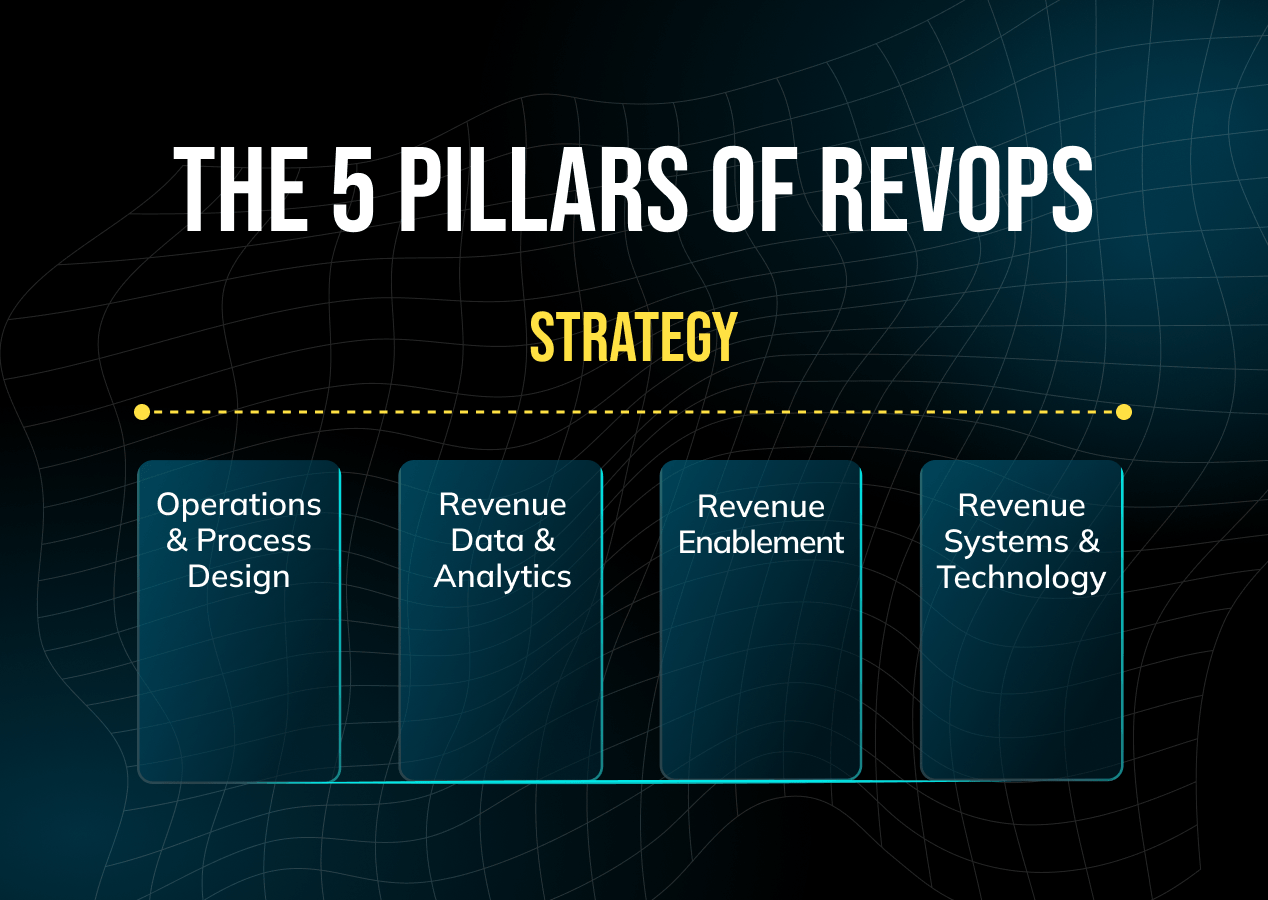
The 5 pillars of RevOps in B2B SaaS
A complete RevOps function owns five pillars. Most teams are strong in two or three and quietly missing the one that matters most.
1. Strategy
This is the most overlooked pillar, and the one with the highest leverage.
Many RevOps teams are still drowning in CRM administration or fixing lead routing while the real leverage sits upstream: go-to-market motion decisions, commission plan design, capacity models, territory design, forecasting.
If your RevOps team is not in the room when you decide how next year's number gets built, you are using a strategist as a technician.
The tell is easy to spot. Ask who builds your capacity model. If the answer is finance alone, or a spreadsheet the CRO inherited, you have a gap. Ask who runs the diagnostic when a quarter misses. If the default answer is "sales did not execute," you have a bigger one.
2. Operations and process design
This pillar builds the scalable path from a lead entering the CRM to a contract renewing or churning.
The goal is not a process for its own sake, it’s about freeing up time for your GTM ICs. Every hour your AEs spend fighting the system is an hour they do not spend selling, and every hour your CSMs spend reconciling data is an hour they do not spend on outcomes.
3. Revenue data and analytics
RevOps builds the analytics layer for your core go-to-market metrics and, critically, owns their definitions.
That means conversion and win rates, customer acquisition cost, churn, net dollar retention, average contract value, and sales cycle length. Not just the calculation. The definition, the filter logic, the stage-transition criteria, the segment boundaries.
Definition ownership sounds bureaucratic until the first time your CRO and your CFO bring different win rates to the same board meeting. Then it is the only thing that matters.
4. Revenue enablement
Enablement in a RevOps context is not onboarding slides. It is two jobs.
The first is adoption: making sure the processes you designed are actually used, which is where most process work dies. The second is performance: using the data layer to make your go-to-market team measurably better at the job through strategic insight and group coaching.
5. Revenue systems and technology
This pillar streamlines go-to-market execution across tools. The CRM remains the core layer, whether that is HubSpot, Salesforce, or Attio, plus everything connected to it: CPQ (Configure, Price, Quote), marketing automation, customer success platforms, forecasting tools, conversation intelligence.
With AI, this pillar has changed shape. RevOps must now centralise the company's AI-GTM tooling effort and face a constant stream of buy versus build decisions, including the newer question of whether your CRM's native AI features already cover what a point solution is selling you.
When should you hire your first RevOps person?
The size of a RevOps team varies widely by stage. The trigger does not.
Rule of thumb: from five individual contributors in your go-to-market team, hire your first RevOps person. In practice this usually lands just after a seed round.
Hire a generalist, not an administrator
The profile for hire number one should be a generalist combining process design, analytics, and systems architecture. Their focus is straightforward: make sure sellers spend more time selling and CS has more capacity for customer outcomes, and make sure the data those teams generate is clean enough to build on.
The cost of inaction has gone up
The point where formal RevOps governance structures become necessary is roughly a 100-person organisation. Structuring RevOps as a strategic partner earlier avoids the alignment debt that accumulates once you scale past that point and an alignment debt behaves like technical debt. You do not notice you took it on. You notice it when all your GTM teams start pulling into different directions and it is tougher and tougher to re-align them.
But more than that, in the age of AI RevOps builds the scalable processes that produce clean data, and clean data is the foundation for anything agentic you want to layer on top. Every quarter you run without that foundation is a quarter of data you will either clean up later or write off entirely.
How should you measure the success of a RevOps team?
The most common mistake is setting the bar in the wrong place, not too low but too abstract. In most companies there is simply no measurement structure in place yet to attribute movement in a revenue KPI to RevOps work.
So sequence it.
Stage 1: Measure project delivery
Initially, measure completion of specific, scoped projects. New sales process launched. Lead routing rebuilt. Forecast cadence live. Pipeline hygiene standard defined and adopted.
This is not a soft metric. It is the correct metric for a function that has not yet built the instrumentation to measure itself.
Stage 2: Measure customer behaviour
Once instrumentation exists, move to the five behaviours Stephen Diorio identifies. Does your RevOps team make customers:
- Buy faster? Reduced sales cycle length.
- Buy more? Upsell and cross-sell ARR growth.
- Buy at a higher price? Deal desk discipline reducing aggressive discounting, or a pricing redesign.
- Stay longer? Reduced churn, extended customer lifecycle.
- Refer to others? A referral program that actually functions.
Important caveat: RevOps influences all five and directly controls none of them. Anyone who tells you otherwise is selling you an attribution model that will not survive its first board meeting. The honest framing is that a RevOps team's presence should move the needle on these, and their absence should be visible when you look at them.
Stage 3: Own the GTM board reporting layer
At maturity, RevOps owns the questions the board asks. For example, on the sales side RevOps starts owning: bookings versus plan, quota attainment distribution, pipeline coverage, forecast accuracy, SQO-to-close conversion, win rate, CAC payback, and planned versus actual capacity.
The equivalent marketing and CS layers sit alongside it. The unlock is not the metric list. It is consistent across meetings and slicing everything by segment, geography or ICP, because that is where the strategic insight hides.
The anti-pattern
Do not measure RevOps on ticket throughput. It is the easiest metric to collect and the most destructive one to optimise, because a team that closes 200 tickets a month is a team with no time to ask whether those 200 tickets should have existed.
{{cta}}
What changes with AI?
With AI entering the picture, the RevOps team should become an even more essential puzzle piece to your company for several reasons:
First of all, the RevOps team is the team that has to make sure that the data foundation actually exists for any agentic layer to be put on top. Without having the architecture developed and a well-defined funnel, agentic results will suffer.
Secondly, the team is by default very technical and therefore in a pole-position to run a lot of the agentic experiments, which helps to scale AI initiatives. At the same time, the team is data-driven enough to derive the correct decisions from those experiments and build only those solutions that actually scale.
Last but not least, centralizing AI initiatives for GTM in the RevOps team allows other teams to spend more time selling, working with customers or running campaigns. So AI in GTM becomes RevOps lever to be a multiplier for the GTM ICs by helping them be even better at their core jobs.
Why most B2B SaaS companies still get RevOps wrong
If the case is this clear, why is the function still scoped as admin in so many companies?
Most often, the simple reason that RevOps is not set up for success is because it lacks the strategic mandate. It’s still the CRM administrator owning the GTM tech stack, which is part of the job, but never the full job.
If you want RevOps to succeed, find yourself that strategic generalist, have them report to the CEO, CFO, COO, or CRO and treat them as the right hand for that person for all revenue matters.
Lorem ipsum dolor sit amet
Lorem ipsum dolor sit amet, consectetur adipiscing elit. Suspendisse varius enim in eros elementum tristique.
Need to bring order to your data, processes, and systems?
Our RevOps expert team supports B2B SaaS & tech companies like Infoniqa, Sipgate, and RapidData every day with exactly this challenge.
THe Bottom Line
Should you invest in RevOps right now?
If you have five or more go-to-market individual contributors, a forecast you do not fully trust, and any plan to put AI on top of your revenue data, the answer is yes, and the hire should be a generalist with a strategic mandate rather than a systems administrator.
If you have three reps and a founder still closing every deal, wait. Spend the time defining your metrics instead, because that work does not require headcount and it is the thing your first RevOps hire will otherwise spend their first quarter on.
The one thing not to do is hire the function and scope it as admin. That is how companies conclude RevOps does not work, when what did not work was the job description.
Your questions answered
What does a RevOps team actually do?
A RevOps team owns five pillars: strategy (go-to-market motions, capacity planning, commission plan design, forecasting), operations and process design, revenue data and analytics including ownership of metric definitions, revenue enablement, and revenue systems and technology.
What is the difference between RevOps and Sales Operations?
Sales Operations optimises the sales organisation. Revenue Operations owns the entire revenue process across marketing, sales, and customer success, including a shared data foundation, processes, and systems. RevOps is the broader, more strategically positioned function.
When does RevOps make sense for a B2B SaaS company?
Around five individual contributors in the go-to-market team, which in practice usually lands shortly after a seed round. Formal RevOps governance structures typically become necessary at around 100 employees.
Who should RevOps report to?
The CEO, CFO, COO, or CRO. What matters is the strategic mandate and the role as that person's right hand for all revenue matters. Reporting deep into the sales or IT organisation pushes the function back into pure administration.
Which metrics fall under Revenue Operations?
Conversion and win rate, customer acquisition cost and CAC payback, churn, net dollar retention, average contract value, sales cycle length, pipeline coverage, forecast accuracy, and quota attainment. What matters is not just the calculation but a consistent, shared definition of each metric.